

This isn’t a feature wave; it’s a new way to build and distribute AI, already spreading across teams (even if more slowly elsewhere).
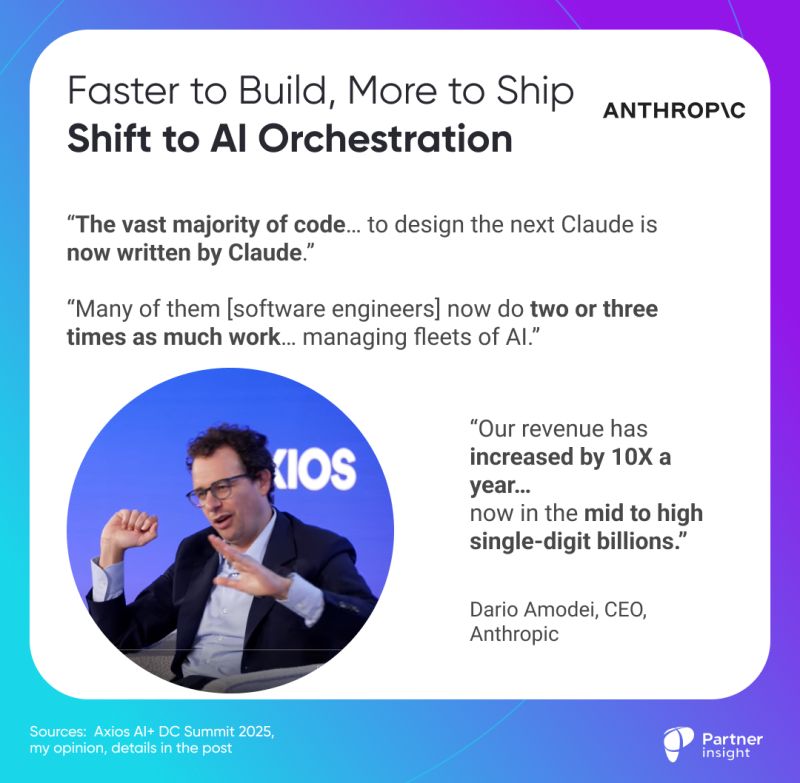
At the Axios AI+ D.C. Summit, Anthropic CEO Dario Amodei shared a candid, B2B-grounded view of AI adoption.
Anthropic studied 130 engineers: many have shifted from writing code to orchestrating agents.
“Many of them now do two or three times as much work… rather than writing code, they’re managing fleets of AI systems.”
10X revenue signals the B2B adoption story
“Our revenue has increased by 10X a year… it’s now in the mid to high single-digit billions.”
That implies roughly $5–8B today, up from $1B in 2024.
For skeptics: B2B customers don’t pay billions for novelty - they’re seeing measurable value.
What makes this wave different:
Self-improvement loop has begun
“The vast majority of code… to support Claude and to design the next Claude is now written by Claude.”
This starts a positive feedback loop where each generation helps build the next—accelerating capability beyond human-limited cycles.
Capability compounds on schedule
“Every 3 months we’ve released a model that improves in a straightforward log-linear way… the curve is smooth; the wiggles are perception.”
Yes, Dario is talking his book.
But the question remains: what happens when software is 3X cheaper to create and starts improving itself?
We don’t get a bit more software.
We get 3–10X more products, agents, and automations—deployed where the data lives, woven into other apps, and evolving monthly.
The bottleneck shifts from production to security, governance, deployment, integration, and lifecycle management.
Three enterprise paths:
Internal app stores of approved agents - most flexible, tech heavy.
Cloud marketplaces (AWS/Azure/GCP) - familiar procurement, governance, and budgets
Large specialized platforms (Salesforce, Workday, Notion, CrowdStrike, etc.) - simpler start, scope limited to those ecosystems.
What this means for alliance leaders
Marketplaces become the control plane
Marketplaces evolve into AI management, governance, and deployment platforms. As teams run AI fleets, enterprises will use cloud marketplaces to procure, entitle, meter, evaluate, and retire AI apps and agents at scale.
Partner roles flip: reseller → orchestrator
When customers manage fleets of Agents instead of discrete apps, partners orchestrate workflows and outcomes, not just redistribute licenses. That demands deeper technical competency and outcome-based services.
The ecosystem is entering an exponential phase
“Every 3 months… log-linear improvement.”
The tech curve is predictable; the challenge is keeping the partner strategy in sync with new reality.
Alliance leaders who treat this as incremental change will be planning for a market that no longer exists.
Source: (video)

Latest Insights & Analysis
We help our clients to define customer-centric strategies that stimulate innovation and create value