

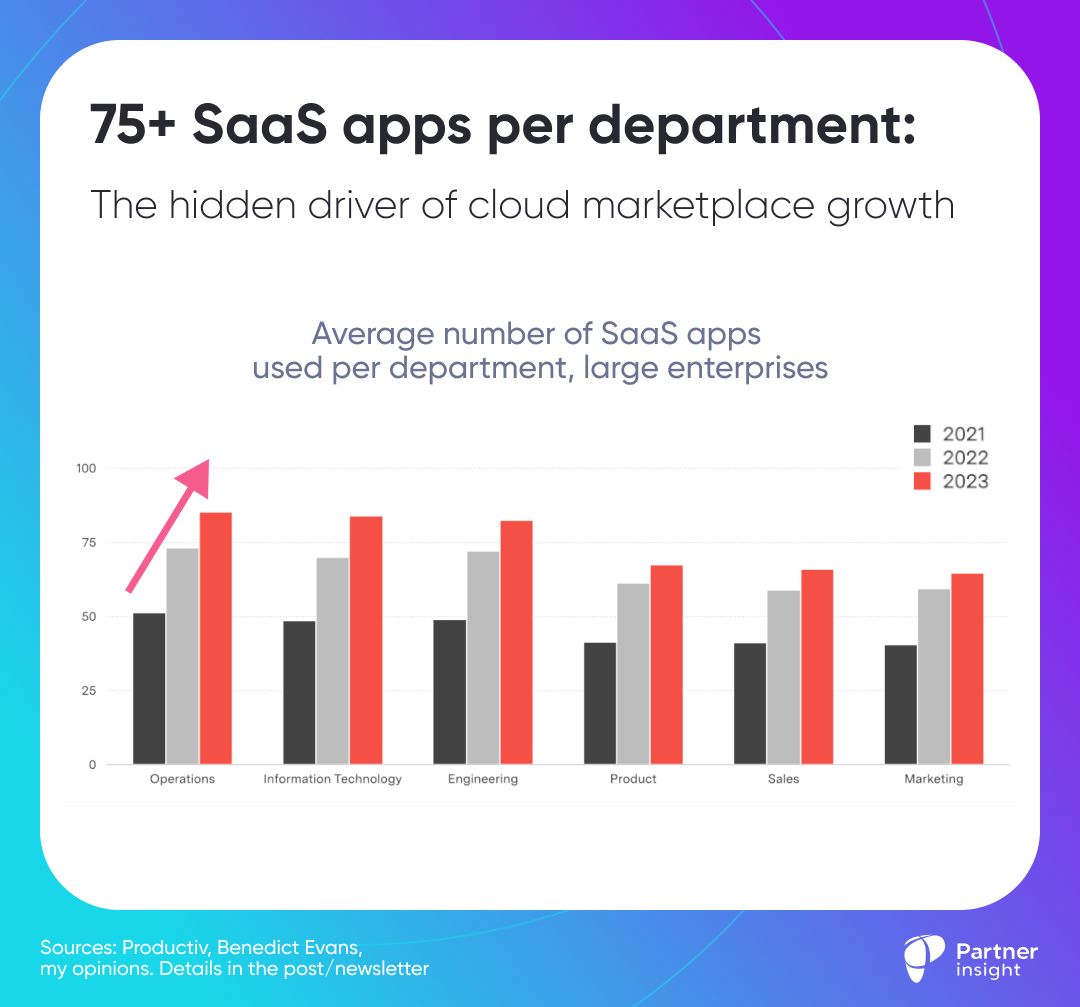
📊 Let's break down what the data reveals
Operations, IT, and Engineering departments lead the pack, each managing 80-85 different SaaS applications - a staggering 70% increase from 2021.
Even traditionally lighter tech users like Marketing now juggle 60+ apps, up from 40 in 2021.
💎 This proliferation creates three critical challenges for enterprises and software vendors:
Procurement Complexity:
Enterprise sales cycles become increasingly burdensome as companies manage more vendors, contracts, and renewal dates.
Budget Fragmentation:
With departments running dozens of subscriptions, software budgets are scattered across multiple cost centers and purchasing channels.
Integration Overhead:
IT teams struggle to secure, manage, and integrate an ever-expanding portfolio of applications.
🛒 Here's the reality check:
Imagine selling another tool to a department already managing 80+ apps. Not only do they barely track what they have, but their management now scrutinizes every new line item.
🎯 This explains the unprecedented growth of cloud marketplaces.
Their advantages for procurement and security teams are compelling:
Consolidated procurement and billing
Simplified vendor management
Leverage of existing cloud commits
Native integration with cloud infrastructure
Enhanced security and compliance
Recent Boston Consulting Group (BCG) data confirms this shift: 55% of enterprise buyers now spend over 10% of their IT budgets through marketplaces, with two-thirds planning to increase this channel.
⚡ For software vendors who sell to enterprises, the winners in 2025 won't just be those who list on marketplaces - they'll be the ones who transform their entire GTM strategy around this new purchasing reality.
What's your approach to navigating this fundamental shift in enterprise software consumption?

Latest Insights & Analysis
We help our clients to define customer-centric strategies that stimulate innovation and create value