

AWS’s new whitepaper argues that Agentic SaaS ≠ new SaaS —it’s SaaS upgraded. Here’s my read and what it means for Cloud GTM leaders.
“Rethinking SaaS in the Agentic Era” is a great framework, but it reads like architecture, so here is my GTM take.
What the paper says:
Agents don’t replace SaaS—they upgrade it
Agents add autonomy and reasoning on top of SaaS benefits (scale, agility, efficiency) rather than replacing them.
AWS cites a Gartner view that 15% of work decisions will be made autonomously by agentic AI by 2028—a balanced take.
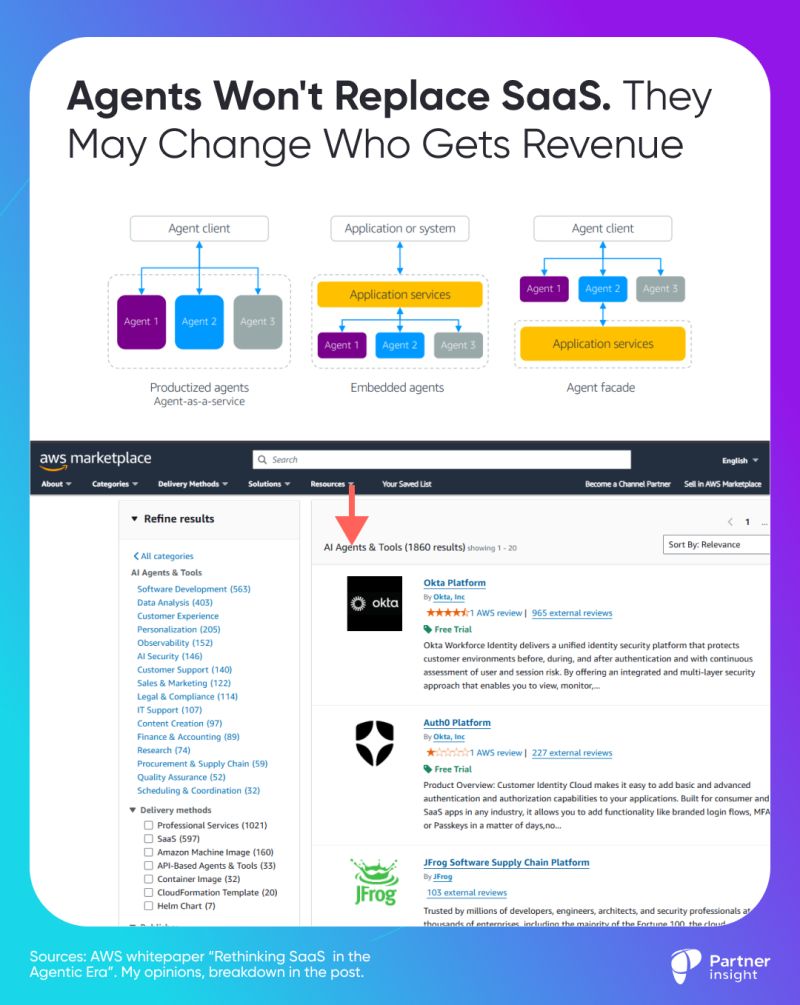
3 agent delivery patterns
Productized agents - agent-as-a-service you can list and sell on marketplace
Embedded agents - inside your SaaS
Agent façade - agents orchestrate an existing app as a GenAI overlay. Lets you ship an “agentic experience” quickly and learn usage patterns.
Multi-agent systems (MCP/A2A) are “the next level of power and possibilities for agents”
Expect agent swarms across multiple vendors with distributed identity/authorization and context passing between agents.
Dedicated vs. shared vs. multi-tenant agents
The paper contrasts per-customer agents with shared, multi-tenant agents. The shift is to treat users as tenants, so every request runs with tenant-specific context, data, and policies—requiring robust isolation.
Key product plays
Near-term Embed/Extend to defend base and expand users.
Medium-term Expand (new agentic product for current accounts).
Selective Build bets for net-new segments your agents unlock.
What this means for Alliance leaders
Decide your Agent strategy
If you can deliver a coherent outcome with minimal setup, ship a productized agent and list it (with outcomes, guardrails, and pricing).
If adoption hinges on existing workflows/data moats, keep it embedded and sell “agent-enabled” tiers.
Use a façade agent to test demand before re-building.
Value prop shifts to outcomes
We’ll moving beyond “seats + features” towards selling tasks completed—but we need AgentOps and new KPIs to track completion/accuracy, token efficiency, cost per tenant, etc.
Pricing will change, but expect hybrid models and careful transitions.
Ecosystem GTM = multi-agent GTM
Partnership plays where your agent collaborates with others become important.
I’m watching how security and revenue sharing evolve for multi-agent value chains—this may shape a new form of co-deliver and co-sell.
What Amazon Web Services (AWS) is trying to say
It offers a blueprint for ISVs to think through—and de-risk—enterprise agent adoption.
It nudges to package agents as sellable SKUs (listed and sold via Marketplace) while standardizing on AWS primitives for identity, data boundaries, and observability.
If you productize agents, marketplaces become a distribution and monetization channel. Embedded agents stay within existing GTM but still change positioning and pricing
What’s your take?
Source: AWS Whitepaper

Latest Insights & Analysis
We help our clients to define customer-centric strategies that stimulate innovation and create value