

Enterprise customers can now burn their Azure credits to buy its HCM software on marketplace.
Here's how they're turning a cloud marketplace into strategic GTM accelerator.
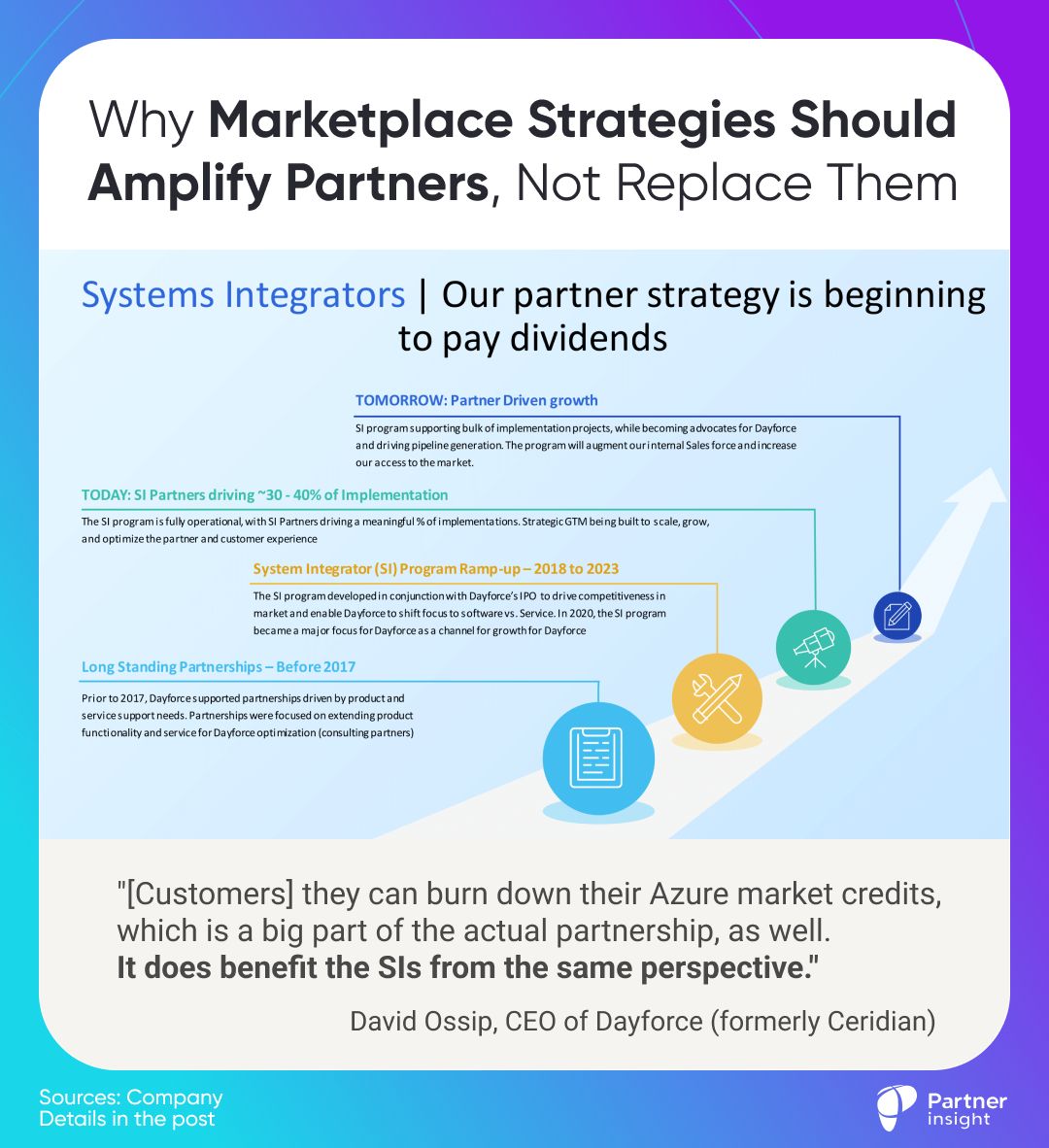
Dayforce (formerly Ceridian) serves 7,000+ customers globally with unified HR, payroll, and workforce management on a $1.5B ARR platform. Their recent Microsoft Azure Marketplace launch signals more than simple distribution expansion—it's a calculated move to amplify an already successful partner strategy.
The Azure Credit Unlock
"[Customers] can burn down their Azure market credits, which is a big part of the actual partnership," confirmed CEO David Ossip during Q1'25 earnings. This seemingly simple capability removes procurement friction that typically slows enterprise HCM decisions.
But the real strategic value lies in how marketplace integration multiplies existing partner momentum.
From Zero to Partner-Driven Growth Engine
Dayforce's transformation showcases methodical partner program evolution:
2017: Launched System Integrator program
2020: Made SI partnerships core focus
2025: Partners now drive 40% of implementations with "SI prime deals at 50% overall"
Partners amplify the company's global reach:
57 countries covered directly by Dayforce,
150+ additional countries serviced through partners.
CEO Ossip detailed their approach:
"We have different layers or different levels of SI partnerships. We started with the Tier 1s... we have very strong Tier 1 SI partners that we use typically in the large enterprise space. When we go into the enterprise, major markets, and emerging spaces, we typically bring on a different set of SIs along the lines of groups like BDO."
As Ossip emphasized: "The use of the SIs really allows us to scale the organization without building out a tremendously large services organization. It also helps us in terms of building out the pipeline, influence of the actual pipeline, as well."
The Marketplace-Partner Flywheel
The Azure marketplace strategy creates aligned incentives across the ecosystem. Partners benefit from accelerating their ability to position Dayforce within enterprise accounts with existing Microsoft spend.
This creates a virtuous cycle
Strategic takeaways for alliance leaders:
Use marketplace presence to tap cloud commits, remove friction and accelerate deal velocity
Think about partner programs and marketplace as force multipliers
Track partner-influenced deals beyond sourced attribution – Dayforce measures "SI involvement in each of our sales" plus "percentage of kickoffs and projects primed by SIs"
The lesson is clear: successful marketplace strategies amplify existing partner ecosystems rather than replacing them.
How are you structuring your strategy?

Latest Insights & Analysis
We help our clients to define customer-centric strategies that stimulate innovation and create value