
Sometimes, yes.
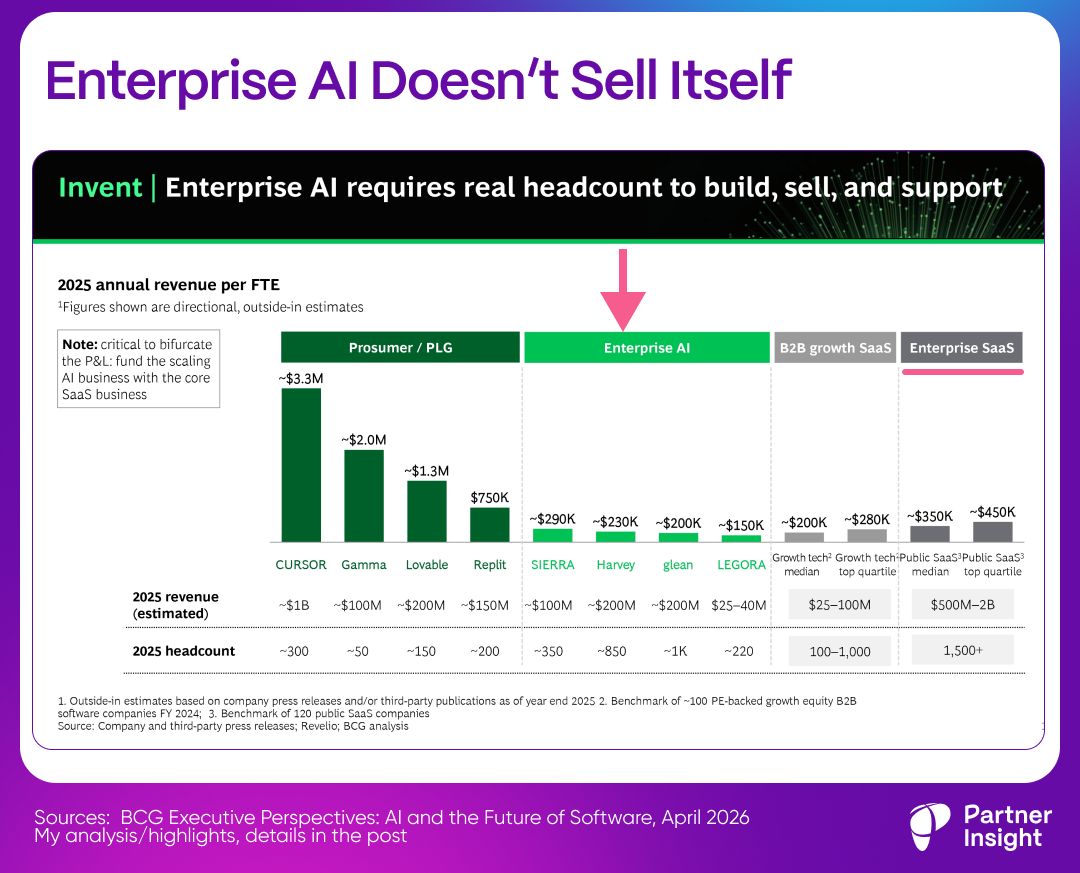
Cursor is reportedly generating $3.3M in revenue per employee. Gamma is at $2M. Lovable at $1.3M.
That is the magic of prosumer / PLG AI when it works.
But BCG’s latest AI software report shows a very different picture for enterprise AI.
Enterprise AI companies look much less like Cursor and much more like traditional B2B companies:
Sierra: $290K revenue/FTE
Harvey: $230K revenue/FTE
Glean: $200K
Legora: $150K
BCG’s conclusion: “Enterprise AI requires real headcount to build, sell, and support.”
That line kills one of the biggest myths in AI GTM.
Yes, there are extreme exceptions.
Anthropic’s growth is almost impossible to benchmark. It said its run-rate revenue surpassed $30B, up from $9B at the end of 2025 and $14B when it announced its Series G in February.
But most enterprise AI companies are not Anthropic.
They still need:
Sales teams
Implementation support
Security reviews
Procurement navigation
Partner ecosystems
Executive alignment
Usage expansion
The playbook is changing. But the fundamentals stay the same.
In fact, enterprise AI may require a more sophisticated GTM motion than SaaS did.
Because AI value is often realized after the sale.
BCG underscores that for AI applications, usage is the core driver of value, pilots are common, revenue is less stable, and gross margins vary widely.
Enterprise AI sales are not just: Sell seats → expand seats → renew ARR.
It is becoming: Prove workflow value → drive usage → expand consumption → route procurement through the customer’s preferred cloud relationship.
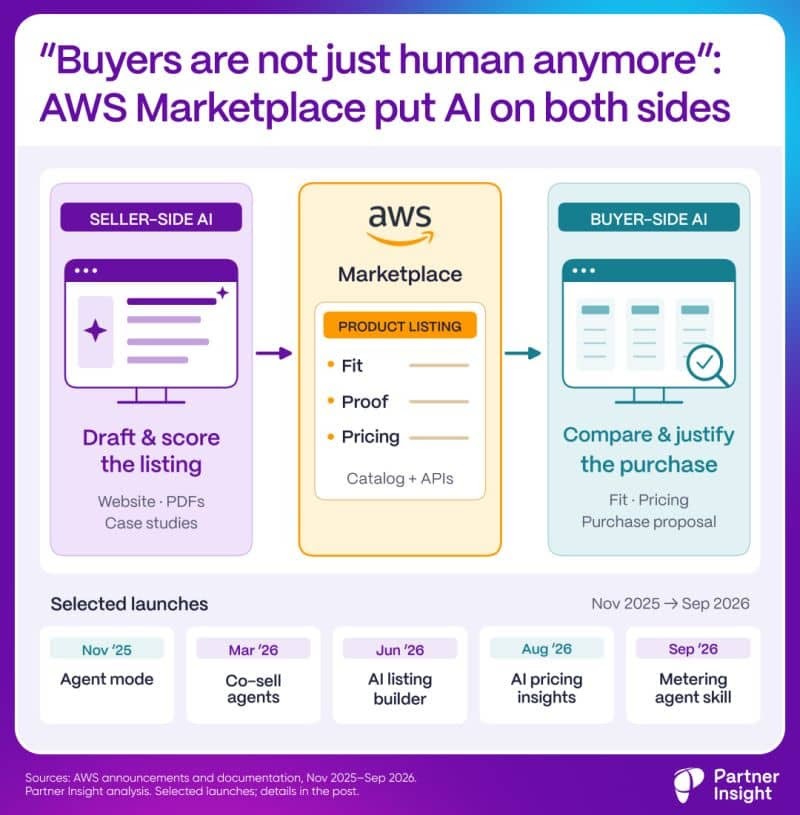
That is exactly why cloud partnerships and marketplaces are becoming central to AI GTM.
OpenAI started with Microsoft, but expanded with AWS too 2 weeks ago - and Amazon Web Services (AWS) explicitly says customers can apply OpenAI usage toward existing AWS cloud commitments.
Anthropic is available across Amazon Bedrock, Google Cloud Vertex AI, and Microsoft Foundry.
Replit and LangChain were just named Google Cloud Marketplace Partners of the Year in AI-related categories.
Best-in-class AI companies are not just building better products.
They are building better distribution around the clouds.
The key lesson for Cloud GTM leaders:
Enterprise AI is turning sales into a cloud-aligned, partner-led, usage-driven motion.
The companies that win will combine:
PLG where possible
Enterprise sales and partners to accelerate sales
Marketplace procurement to reach budgets already allocated
Co-sell where hyperscalers and partners already own the customer relationship
Customer success and ecosystems to drive usage, stickiness and full lifecycle
AI changed the GTM playbook.
But it did not remove the need for GTM.
If anything, the best enterprise AI companies are proving the opposite.

Latest Insights & Analysis
We help our clients to define customer-centric strategies that stimulate innovation and create value