

Here are some of the insights I’m taking away from sessions with Will Kearl, Elizabeth Beals and Rajesh Ramankutty:
1. Marketplaces are outgrowing cloud and becoming the default route to buyers
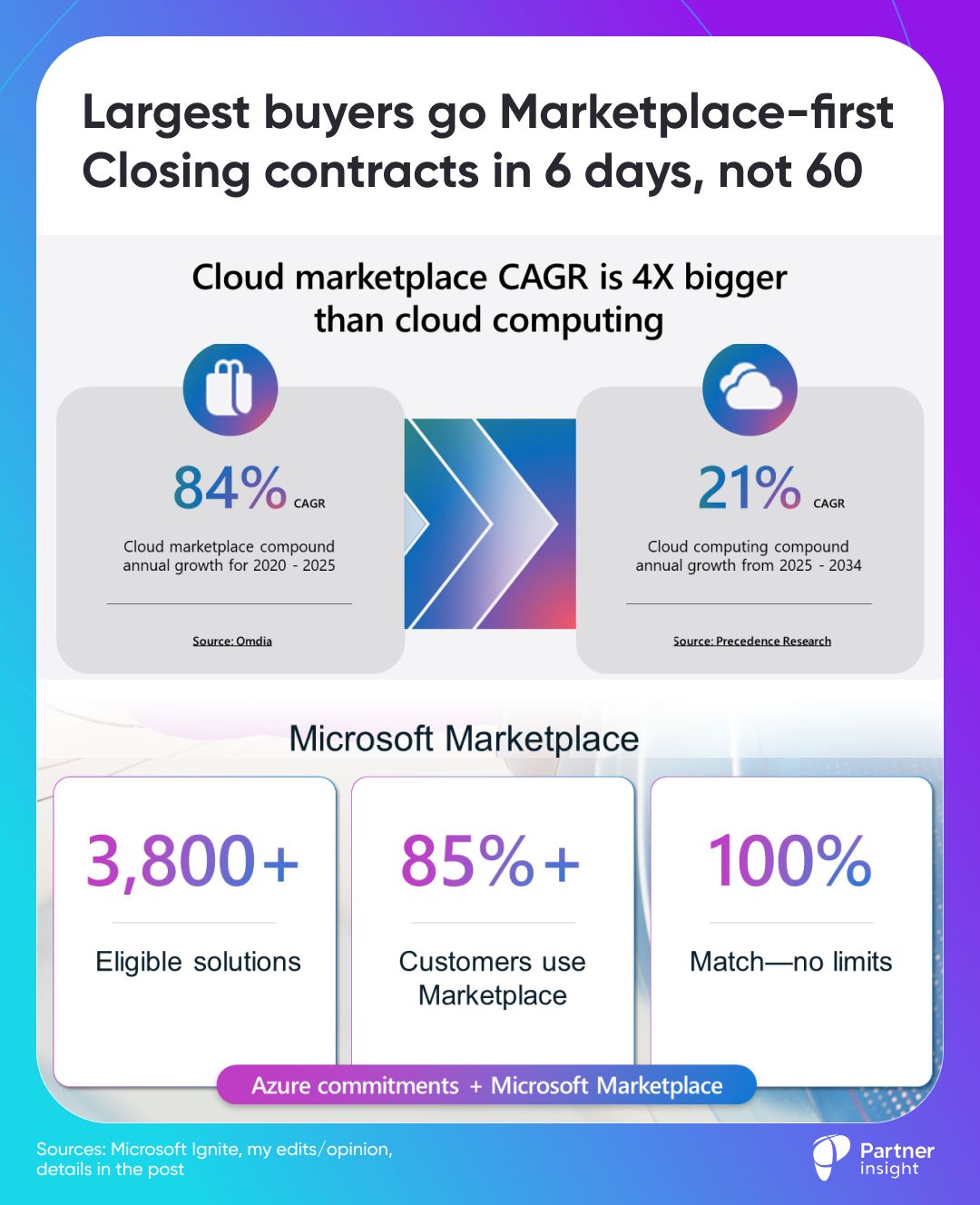
Cloud is growing 21%, but cloud marketplaces are growing about 4x faster at 84%.
The message was simple: Average enterprise runs ~600 apps and the only realistic way to bring that ecosystem with you to the cloud is through marketplaces.
Over the last year, Marketplace sales grew 2X (doubled), and customers who use Marketplace increased their average spend by 75%.
2. Being MACC-eligible and discoverable is now table stakes
If the customer has a Microsoft Azure Consumption Commitment (MACC), you’re selling against pre-committed budget, not net-new spend – and Marketplace becomes the easiest way to use it.
Microsoft already has >3,800 MACC-eligible solutions, and 85% of MACC customers are transacting through Marketplace.
3. Use 100% MACC drawdown as your strategic lever
100% MACC drawdown on eligible Marketplace deals isn’t new, but today Microsoft is the only hyperscaler still doing 1:1 (no cap), while others cap marketplace usage at ~25%
This was called “one of the most generous benefits” for customers
4. Marketplace is becoming a procurement engine – and in some enterprises, a policy
Mars’ procurement lead explained that Marketplace cut contracting time from 60 days to 6 days (90% faster).
If an offer is in Marketplace, they know controls are in place via standard contracts and security, so procurement now operates as Marketplace first – even for low spend.
They also use large SaaS renewals (Databricks, Citrix) through Marketplace to balance against MACC consumption and adjust renewal strategy to optimize MACC drawdown.
5. Marketplace is an extension of Azure security – and a new observability layer for spend
Marketplace is an extension of your Azure environment: the same security model and policies apply.
On the finance side, buyers are using Marketplace as an observability layer for software: one place to see vendors, overlap, and MACC impact.
6. Discovery now happens inside Teams, Copilot and Azure – your listing is your new SEO
Marketplace offers now surface directly in Teams, Microsoft 365 Copilot, Foundry and Azure Portal. You can ask Copilot in Azure what you need and get Marketplace recommendations with links straight to listings.
So your listing metadata, categories and value prop serve as your in-product SEO across the Microsoft estate.
If you lead alliances, takeaways are simple:
Treat Marketplace as the front door for AI and cloud deals
Build your commercial story around Marketplace, commits and procurement value
Align with how buyers are already standardizing their AI, cloud and apps spend

Latest Insights & Analysis
We help our clients to define customer-centric strategies that stimulate innovation and create value