

The best pitches win by showing “customer value” and “why we win”. Here is a clean example from JFrog’s investor deck.
What to copy:
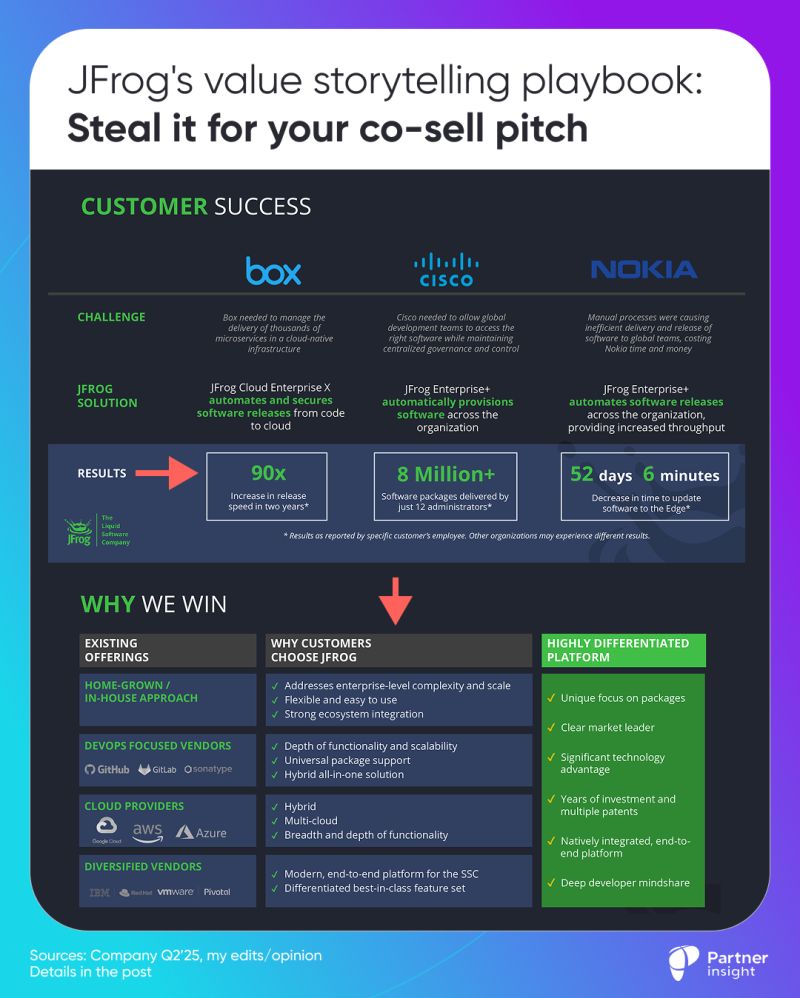
Start with Outcome-Oriented Customer Stories:
Look at how they position customer wins. Notice what's missing? No jargon. No feature lists. Just quantified business impact that anyone can understand.
"Challenge -> Solution -> Result" Formula
This is a classic and highly effective storytelling structure. It’s simple, logical, and focuses on what the customer actually cares about.
Quantifiable, Headline-Worthy Results
They don't just say "faster." They say "90x increase in release speed."
They don't just say "more efficient." They say "52 days to 6 minutes."
These are staggering, memorable metrics that a partner's sales team can easily recall and use in a customer conversation.
Logo Power
Using massive, respected brands like Box and Cisco provides instant credibility.
It answers the unspoken question: "Have you proven this at enterprise scale?"
Clear Competitive Differentiation
Make competitive positioning equally precise
Know Your Rivals
They don't just list competitors; they categorize them (Home-grown, DevOps vendors, Cloud Providers, etc.) and explain differentiation against each segment. This shows deep market understanding.
Simple "Why Us" for Each Category:
For each competitor type, they provide a concise, compelling reason why customers choose them instead.
Comparing with Cloud Providers (like Amazon Web Services (AWS), Microsoft Azure), they highlight "Hybrid," "Multi-cloud," and "Breadth and depth of functionality."
They turn potential weakness (competing with hyperscalers) into a strength (we offer what they don't: true neutrality and greater depth).
NB: this example is a “neutral” deck. Adjust your pitch to your audience.
Differentiated Value
The green box isn't just a list of "best-in-class features".
It's a list of advantages: “Unique focus on packages”, “Multiple patents” and "Deep developer mindshare."
Partners want to work with winners, and this underscores their leadership and differentiation.
3 principles for partner communication:
Start with customer transformation, not product capabilities
Quantify the "why you, why now"
Make differentiation scannable
Add the hyperscaler “better together”
If you’re building slides for co-selling with clouds, highlight their service attach to their field sellers (quantify this if you can):
“Runs on X services + integrates with Y services → drives consumption, migrations and accelerates security/compliance, etc. outcomes.”
You’re telling the cloud AE that helping you helps them.
Companies winning the biggest co-sell marketplace deals aren't those with the most features – they're the ones whose value cloud sellers can easily repeat.
What's your co-sell value framework?

Latest Insights & Analysis
We help our clients to define customer-centric strategies that stimulate innovation and create value