

Especially cloud commits with AWS, Azure, and Google Cloud that are largest, fastest-growing customers IT budgets. Let's break this down.
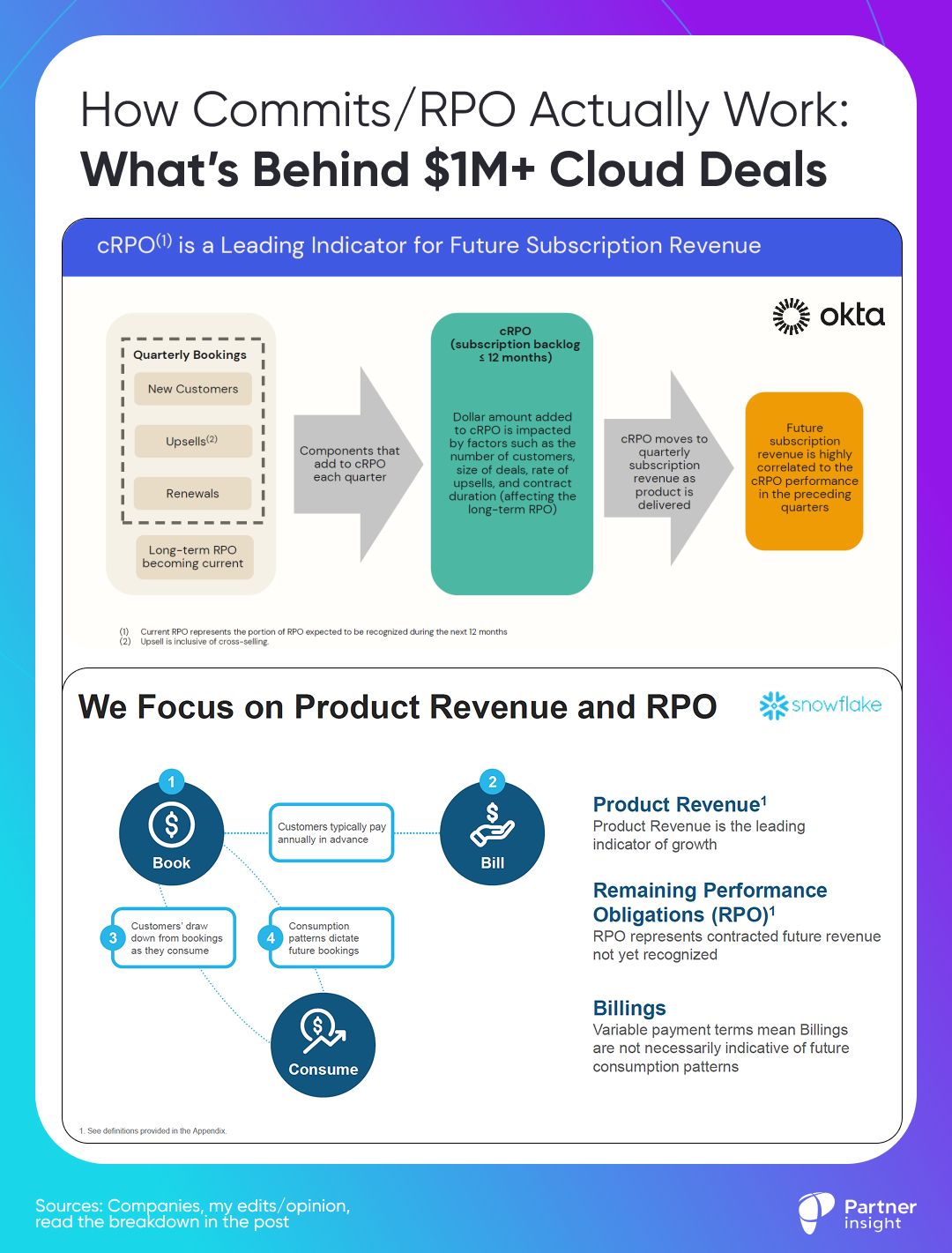
Two slides—from Okta and Snowflake (which also closely track their own customers commits)— explain the entire financial RPO engine from contract signature to cash recognition.
Understanding the Remaining Performance Obligation (RPO) mechanism is also key to unlocking major deals through cloud marketplaces.
Building the Commitment Pool
First - how the commitment pool is created. The Okta slide shows the 'inflow'. It's a combination of sales activities that build a company's contractual future revenue:
New Customers: Landing a new enterprise account
Upsells: Expanding the service with an existing customer
Renewals: Securing the relationship for another term
The total value of these non-cancellable contracts creates the RPO. Think of RPO as a big, guaranteed pool of future revenue that the customer has committed to spend. Okta’s slide also highlights Current RPO —the portion of that pool to be recognized in the next 12 months, which is what CFOs watch like a hawk.
Spending Commits & Recognizing Revenue
So, how does that giant RPO pool get spent? Snowflake’s slide shows the 'outflow'—the simple but powerful Book -> Bill -> Consume cycle.
After the deal is booked (Step 1) and billed (Step 2), the customer starts to "Consume" or "burn down" their commitment (Step 3). For every dollar of service they use, a dollar moves from the RPO pool to the vendor's recognized revenue.
Cloud Marketplace Game-Changer
RPO isn't just a SaaS vendor model; it's the same mechanism behind Amazon Web Services (AWS) Enterprise Discount Programs (EDPs), Microsoft Azure Consumption Commitments (MACCs), and Google Cloud CUDs.
And here is the critical insight for every alliance leader:
In the world of top 3 hyperscalers, this "burn down" phase is your single biggest opportunity.
Because they allow customers to burn down these massive commits by purchasing your software on their marketplaces (25% of total on AWS & GCP, 100% on Azure).
This transforms a customer's rigid cloud budget into a flexible fund that can include your solutions. It's the major shortcut for traditional procurement cycles and tapping directly into the largest pre-approved budget your customer has.
The numbers from all 3 hyperscalers prove it: companies selling via marketplaces see higher close rates/deal sizes.
Your Action Plan for Cloud Marketplaces
Start seeing these cloud commits for what they are: your fastest path to revenue.
Map prospects' active cloud commitments before/during pitching
Build co-sell plays to help customers optimize commit burn
Help hyperscaler sellers show customers how purchasing your product help to burn commits (+ get better cloud discount)
What's your strategy for turning cloud commits into your revenue?

Latest Insights & Analysis
We help our clients to define customer-centric strategies that stimulate innovation and create value