

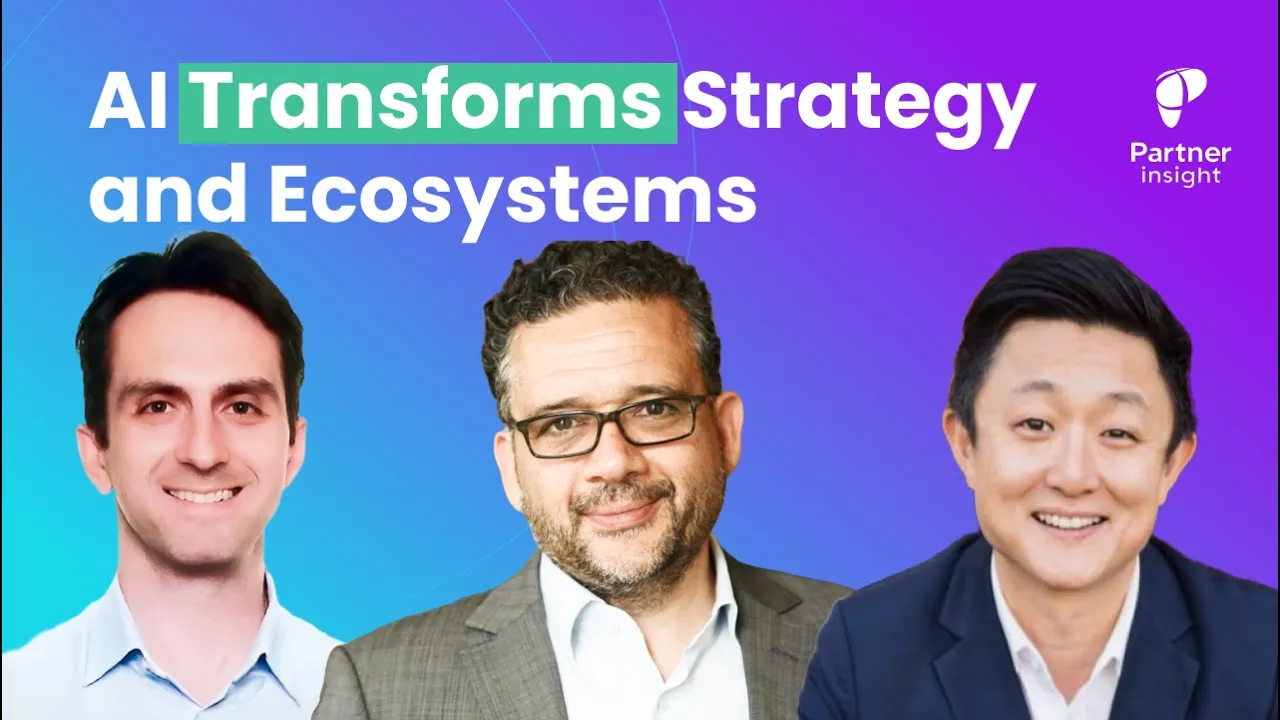
To explore this topic, I turned to two incredible experts:
Michael Jacobides: Professor of Strategy and Entrepreneurship at London Business School. Professor Jacobides is a leading global authority on business ecosystems, advising academia, think tanks, and corporate boards.
Yan Zhang: VC advisor and former COO of PolyAI, one of UK's top AI companies. Yan brings practical wisdom from leading sales, partnerships, and operations and also investing in the AI sector.
Our discussion, which blends academic rigor and hands-on experience, offers a unique perspective on:
How companies adapt to and adopt AI
Business model evolution in the AI era
The rise and influence of AI-driven ecosystems
The Gen AI Paradox: Bridging Hype and Implementation
As Generative AI grows rapidly, Michael Jacobides' recent research unveils a stark disconnect between executive enthusiasm and practical AI implementation.
Jacobides observes: "We're in a very funny and historically unprecedented kind of place where I think that there is both excessive hype because people know it's important but they haven't translated it for their own organizations, and sometimes an under-appreciation of what the technology can do."
This paradox manifests in two key ways:
Funding without Strategy: Boards are writing "very big checks" for gen AI initiatives, yet organizations struggle to integrate these technologies effectively. As Jacobides notes, "People are … saying, 'I don't know what that means. I don't know how to integrate it.'"
Untapped Potential: While there's significant hype, many companies are also "not taking enough advantage of what this technology can offer." This suggests a massive opportunity for those who can effectively harness gen AI's capabilities.
Gen AI Adoption: The Path of Least Resistance
Yan Zhang’s experience in Poly AI and in VC provides a unique perspective on where gen AI is gaining traction. Zhang identifies three key areas where gen AI is seeing successful deployment:
Outsourced Workflows: Gen AI adoption is highest in processes already outsourced to BPOs (Business Process Outsourcing). Zhang explains, "Gen AI... is most quickly fitted in workflows that have already been outsourced." This includes customer service, content moderation, and document processing. The rationale? "Things that have already been carved out of the organization are things that are the first to be automated with gen AI."
AI Component Enhancement: Companies providing core AI functionalities like voice recognition, LLMs, and text-to-speech are seeing significant success as they support other AI-driven products.
Augmentation and Co-pilots: Substantial adoption is seen in areas like sales automation. Zhang notes, "We're seeing a lot of adoption in sales automation, in companies that are using AI to help outbound or enter details into the CRM."
Maximizing Gen AI Impact: Modularity and Strategic Integration
Talking about companies that see most success with AI, Michael Jacobides' research reveals two key factors:
Modularization: Companies with modular digital infrastructures see higher satisfaction and impact.
Jacobides notes, "Companies that already have a digital DNA and infrastructure, where things are modularized, created in neater little packages, can say, 'This is right for me to put a solution that is AI or gen AI based.'" This modularity enables easier integration and adoption.
Systematic vs. Sporadic Use: Organizations that use gen AI systematically, rather than sporadically, report greater impact. Jacobides explains, "You have a much greater impact when you use it not only sporadically but systematically." This systematic approach involves molding processes to accommodate gen AI and applying it to core organizational functions like operations, IT, HR, and legal.
Beyond these factors, Jacobides highlights a critical mindset shift:
"The people that find the greatest excitement are those that don't only think about it as a cost saving... but also those that are trying to either benefit and expand on the opportunities of personalization at the mass level, or those that try to create new revenue models, new ways in which we're able to make money."
This insight suggests that the most successful gen AI implementations go beyond simple efficiency gains, focusing on creating new value through personalization and innovative revenue models.
Potential Moats for AI Solutions: Orchestration, Access, and Future Competitive Advantage
The explosive growth of AI has sparked intense industry debate about sustainable competitive advantages of AI companies and solutions. Yan Zhang offered his insightful perspective into potential moats for AI companies.
Orchestration as a Moat
Zhang emphasizes that while foundational models like GPT-4 or Claude are powerful, they aren’t inherently problem-solvers; they aren’t trained to be. The real value lies in orchestration:
"For you to use these models to solve these problems, there is orchestration that's needed. So what are the components of the problem? Then what model do I use to solve this part of the problem, and then what model do I use to solve the second part of the problem?"
This orchestration - the ability to combine and optimize various AI components - creates a significant barrier to entry. Zhang likens it to assembling a PC or car, where "you're adding a lot of value by optimizing the parts."
Problem Access and Domain Expertise
Privileged access to specific problems and associated domain expertise is crucial for moat-building. Zhang notes:
"Not everybody has access to a specific corporate workflow. So if you want to moderate content, for example, you need to be familiar with the trust and safety rules of many different user-generated platforms."
This combination of problem access and deep domain knowledge allows companies to fine-tune AI solutions in ways generalist models can't easily replicate.
Data as a Differentiator
While data is crucial for training models, Zhang highlights its importance in product creation:
"The data is not just for you to train your models to perform better, but also just for you to create a product or an orchestrated kind of stack of AI models to solve the problem."
Companies with rich, relevant datasets have a significant advantage in creating effective AI solutions.
The Wildcard: Future Model Capabilities
Meanwhile, Zhang acknowledges the looming question: "Will a foundational model come out that's so smart... that it's going to figure out all of these in-between steps?" The answer could reshape the competitive landscape, potentially eroding some current moats.


Latest Insights & Analysis
We help our clients to define customer-centric strategies that stimulate innovation and create value