

This recent Gartner prediction raises a question: Why would AI create more ecosystem roles?
Shouldn’t automation reduce the need for people managing supplier and partner relationships?
I think the answer is in what AI can automate first.
AI is automating routine procurement work
Routine procurement interactions are becoming easier to hand over to agents: supplier checks, risk monitoring, compliance reviews, guided buying, renewals, onboarding and market scanning.
Gartner’s message at its Supply Chain Symposium in May was much more grounded.
Procurement leaders should be careful with agentic AI hype. AI agents can handle bounded tasks. Broader agentic AI, where systems coordinate across workflows, is still early.
They also pointed to a gap between what people think agentic AI can do, what it can reliably do, and what vendor demos show.
So the near-term opportunity is practical: targeted sourcing and procurement use cases.
Procurement starts depending more on trusted inputs
That is where the ecosystem angle becomes interesting.
The more procurement becomes AI-assisted, the more it depends on trusted inputs.
AI can compare vendors faster.
It can screen risk faster.
It can surface contract or compliance issues faster.
But it still needs clean supplier data, reliable partner records, clear ownership, governed workflows and human accountability.
This is why ecosystem roles do not disappear. They move closer to trust, data quality and orchestration.
There is also a readiness gap
Gartner found only 17% of surveyed supply chain leaders are pursuing immediate transformational redesign. 83% are moving incrementally.
The blockers are familiar: low data quality, fragmented vendor landscapes, inconsistent partner data, immature workflows and continued need for human expertise.
That explains why new ecosystem roles are emerging.
AI reduces manual coordination, but increases the need for trusted digital coordination.
What about marketplaces?
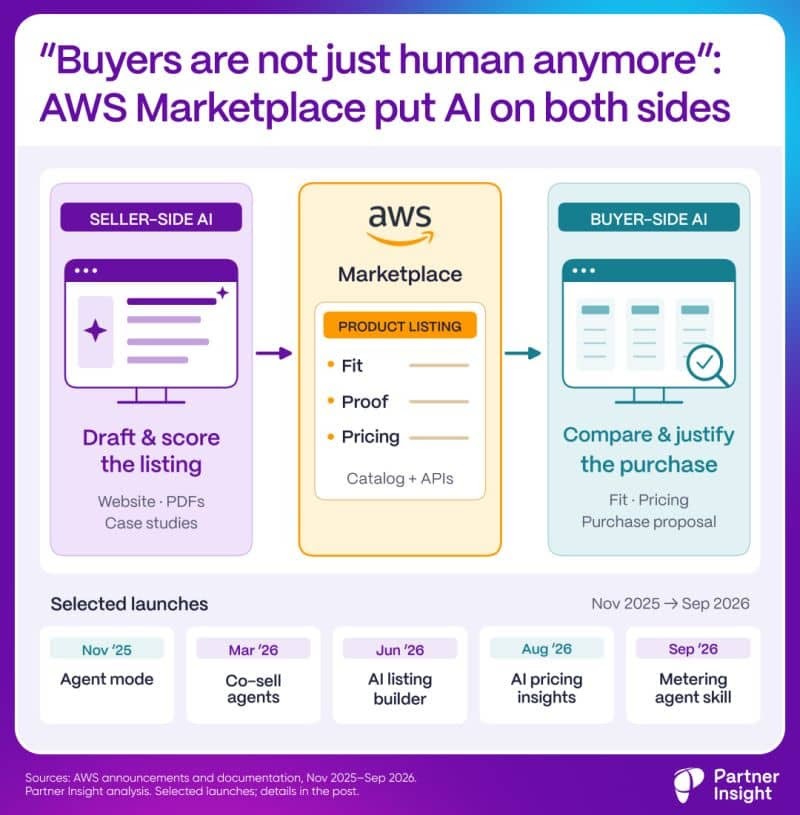
If an AI-assisted workflow is evaluating (software) vendors, it needs more than a polished website or a broad value proposition.
It needs structured proof:
Marketplace availability
Integrations
Security posture
Compliance status
Pricing and renewal paths
References
Support coverage
Partner certifications
That makes marketplace listings more important. A listing is no longer only a storefront. It becomes part of vendor validation.
For a human buyer, missing information creates friction.
For an AI-assisted procurement workflow, missing information can mean being filtered out before a conversation starts.
AI will automate more procurement tasks, but enterprise buying will still depend on credible partners, governed workflows and trusted ecosystems.

Latest Insights & Analysis
We help our clients to define customer-centric strategies that stimulate innovation and create value