
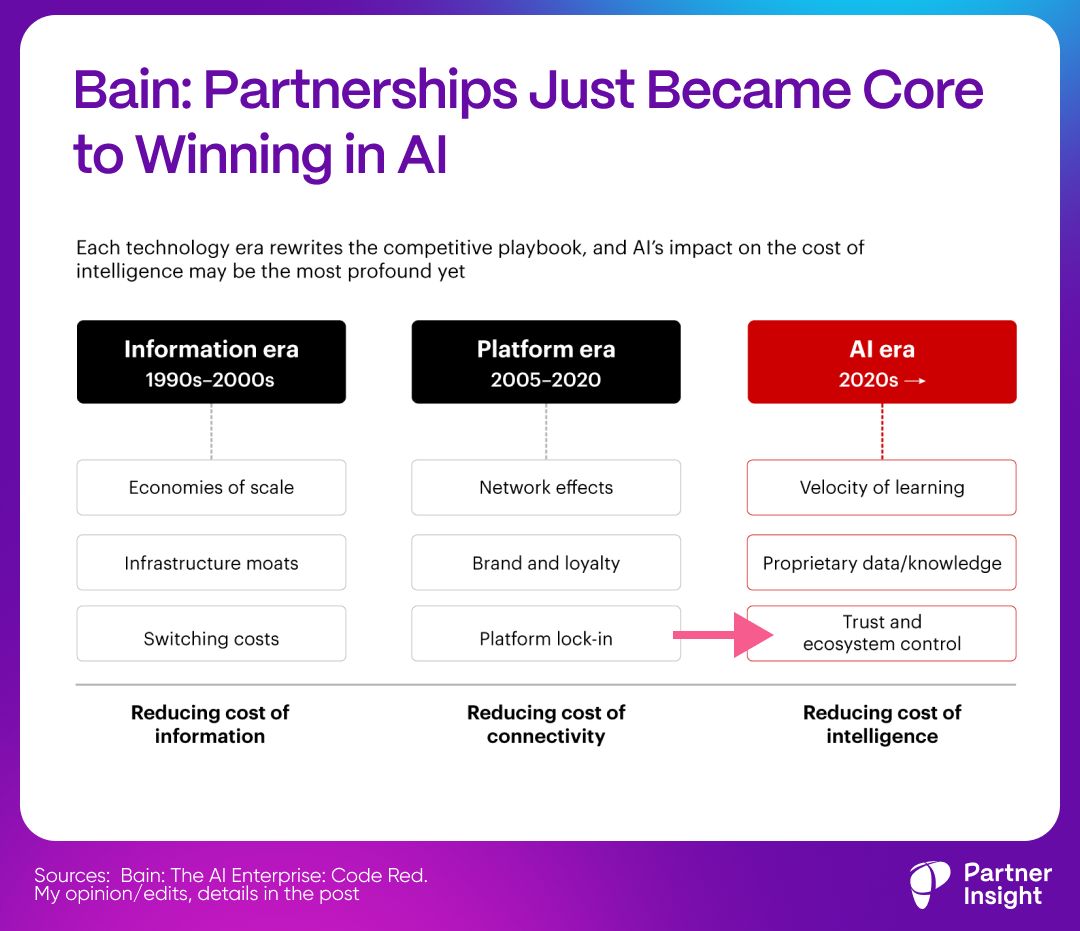
In a new report, Bain & Company maps three tech eras of competition:
Information era rewarded scale
Platform era rewarded network effects
AI era? It rewards three things: velocity of learning, proprietary data, and trust-based ecosystem control.
In AI, advantage will come from learning faster, embedding deeper into customer workflows, and earning enough trust to help orchestrate how work gets done.
“Ecosystem partnerships provide the scale and experience needed to compete”
Competing in AI now requires capabilities that are hard to build in isolation.
AI now spans data, governance, workflows, orchestration, evaluation, and deployment. That creates a much bigger role for ecosystems.
Four implications for alliance leaders:
1. Partnership value now includes learning speed, not just reach
The old question was often: which partners help us sell more?
Now another question matters just as much: which partners help us learn faster?
Who helps you improve implementation?
Who brings reusable patterns across customers?
Who helps your teams adapt as AI capabilities change every quarter?
The strongest partners in the AI era may be the ones that accelerate learning, not just distribution.
2. Trust becomes a real control point
As AI agents start orchestrating more decisions and workflows, the company that earns trust to run those agents gains the control point.
For ecosystem leaders, trust is built through governance, reliability, security and transparency.
This is especially important in enterprise software, where customers will not let AI touch critical processes without strong controls.
3. The services opportunity gets bigger and more operational
Bain also argues that AI has to be industrialized through an “agent factory” — a repeatable process for building, testing, deploying, and governing agents at scale.
That is a major opening for SIs, GSIs, cloud partners, and specialist ecosystem players.
The value will not sit only in access to models. It will sit in workflow design, orchestration, evaluation, governance, and repeatable delivery.
This is why every hyperscaler launched AI agent platforms in the past year.
4. Differentiation moves higher up the stack
Advantage will come from proprietary knowledge, personalized workflows, and strong user communities.
For alliance leaders, that is a signal when choosing where to invest.
The best partnerships will not just add another integration.
They will deepen workflow fit, improve outcomes, and make the ecosystem harder to replace.
3 Lessons:
Treat ecosystem strategy as a company-level competitive asset
Prioritize partners with high learning speed
Build trust and repeatable delivery into your AI strategy early
Where is your org on the AI partnership curve?

Latest Insights & Analysis
We help our clients to define customer-centric strategies that stimulate innovation and create value