

Last week, leaders from Contentsquare, AWS, KnowBe4, and Suger joined our online workshop to share how they coach sellers to convert commits into revenue and how to scale on marketplaces faster. Here are the seven tactics that separate scalers that grow on marketplaces from stragglers:
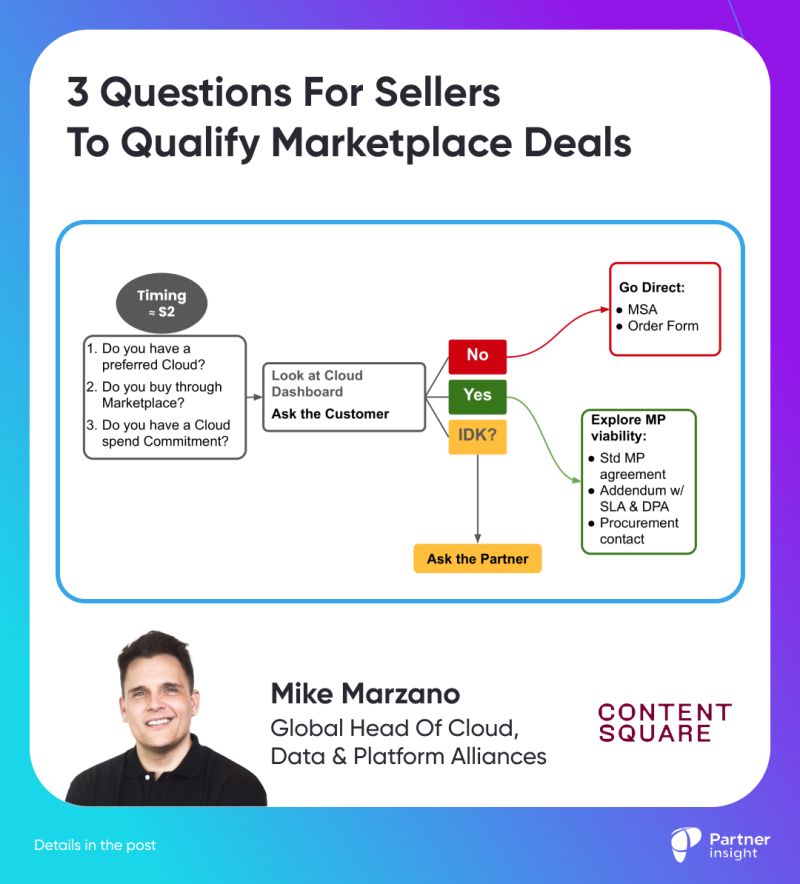
1) Install the 3-Question Framework at Stage 2
Mike Marzano drove $0 to $30M+ in marketplace revenue in 30 months with just 3 people supporting 400 sellers at Contentsquare by making qualification automatic.
His framework triggers when deals hit Stage 2 (validated opportunity, initial sizing complete):
Do you have a preferred cloud?
Do you buy through its marketplace?
Do you have a cloud spend commitment?
Then route based on answers:
Yes → Use marketplace, build private offer, engage cloud AE
I don’t know → Pull in cloud partner team to verify
No → Standard direct contract
Why this works: Asking early (Stage 2, not at contract) gives you time to build the three-way win with customer + cloud AE instead of scrambling at the 11th hour.
2) Comp Neutrality Isn’t Optional—It’s Table Stakes
Every speaker emphasized this: if reps don’t get the same comp for marketplace deals as direct, they’ll route around you.
What top performers do differently:
Neutrality baseline: Marketplace = direct comp (no penalty for 1.5-3% transaction fee)
Velocity kicker: Temporary SPIF (6-12 months) to drive adoption
Proof via data: Track deal size lift and cycle compression to show why marketplace earns the incentive
One ISV scaled to $100M ARR on marketplace by running a time-bound comp-positive program. Over that period, they saw deals close ~30% faster and 20–40% larger on Marketplace — and reps kept using it even after the SPIF ended.
3) Operations Before Heroics
Mike’s quote: “Good operations are worth their weight in gold.”
Contentsquare’s 3-person team scaled to $30M because they invested in:
Pipeline syncing (CRM ↔ ACE/Partner Center)
Propensity-to-buy and engagement scoring for marketplace eligibility
Standardized info bundles for ACE submissions (who we are, deal size, buyer, 3 key asks)
The trap: Alliance leaders try to manually quarterback every deal. That caps you at dozens deals per quarter.
The unlock: Build workflows that let sellers self-serve 80% of marketplace mechanics (eligibility check, private offer request, etc.).
4) Map Marketplace to MEDDPICC (or Your Sales Methodology)
AWS’s guidance: integrate marketplace into your existing sales qualification framework—don’t make it a separate track.
For MEDDPICC users:
Metrics – Tie Marketplace to quantifiable impact: revenue, efficiency, or risk reduction from doing the deal via Marketplace.
Economic Buyer – Identify who owns cloud commercial strategy and commit budget (EDP/PPA, discretionary funds, etc.).
Decision Process – With AWS, map the steps and stakeholders so you can shorten the path to “yes.”
Paper Process – Use Marketplace to streamline onboarding, procurement, and permissions to accept private offers.
Implicate Pain / Champion – Work backwards from customer pain and map champions together with the AWS account team.
Why this works: Sellers already know MEDDPICC. Mapping marketplace to existing muscle memory drives adoption faster than teaching a new framework.
5) Share pipeline with AWS with intent, not volume
From the AWS side, the message was clear: spray-and-pray ACE submissions reduce trust. If you flood AWS with poorly qualified opportunities and no clear ask, you get deprioritized.
What gets attention instead:
Clear stage in the sales cycle
Deal size and timeline
Who the buyer is
2–3 explicit asks (e.g., “intro to procurement,” “validation of cloud commit,” “CIO meeting,” “help positioning Marketplace to CFO”)
When your submissions consistently show that you’ve done the work and know exactly how AWS can help, field teams lean in much more often.
6) Seller Experience Is Your Product
Prashant Pai (leads alliances at KnowBe4, 70K customers) frames it clearly: “Me and my team—we are here to make the seller’s life easier. That is the product we deliver.”
How KnowBe4 operationalizes this:
Workflows designed for seller ease: Not what’s easiest for alliances team
Regular seller audits: Every 6 months, ask “What’s hard? What can we improve?”
Refactor based on feedback: Treat sellers like customers; iterate your internal product
Example: They use Suger’s workflow builder to evolve processes as the company gains marketplace maturity—starting simple, adding sophistication as sellers adopt.
7) Automate Seller Workflows to Remove Friction
Kyle Heisner (leads GTM at Suger) shared examples of workflows that eliminate manual bottlenecks:
Automatically pull MEDDICC data from Gong call recordings → populate cloud co-sell record → cloud AE gets context without seller typing summaries
Auto-intro emails connecting seller + cloud AE when deal hits a defined Stage + meets size threshold
Proof-of-record automation for finance team (eliminates monthly manual reconciliation of cloud disbursements)
The pattern: sellers hate “extra work.” Every manual step you remove makes it more likely sellers will actually use Marketplace.
Why This Matters Now
The $531B cloud commit milestone creates urgency, but only if you can activate sellers to convert it.
Most alliance teams know marketplace matters; they haven’t built the GTM, coaching systems, comp structures, and automations that let sellers run plays without requiring alliance team heroics on every deal.
These seven tactics separate the scalers from the stuck:
Winners build seller enablement infrastructure before chasing volume, automate the friction points that slow adoption, and treat marketplace as a cross-functional discipline (sales + finance + ops + legal), not just an alliance initiative.
If you need to build your Cloud GTM strategy, train your sales team to run marketplace deals and more — join our Cloud GTM Leader course.
Cohort 13 kicks off November 18 (last cohort of 2025).
250+ alumni have used these frameworks to scale, including from listing to 8-figure marketplace revenue.

Latest Insights & Analysis
We help our clients to define customer-centric strategies that stimulate innovation and create value