

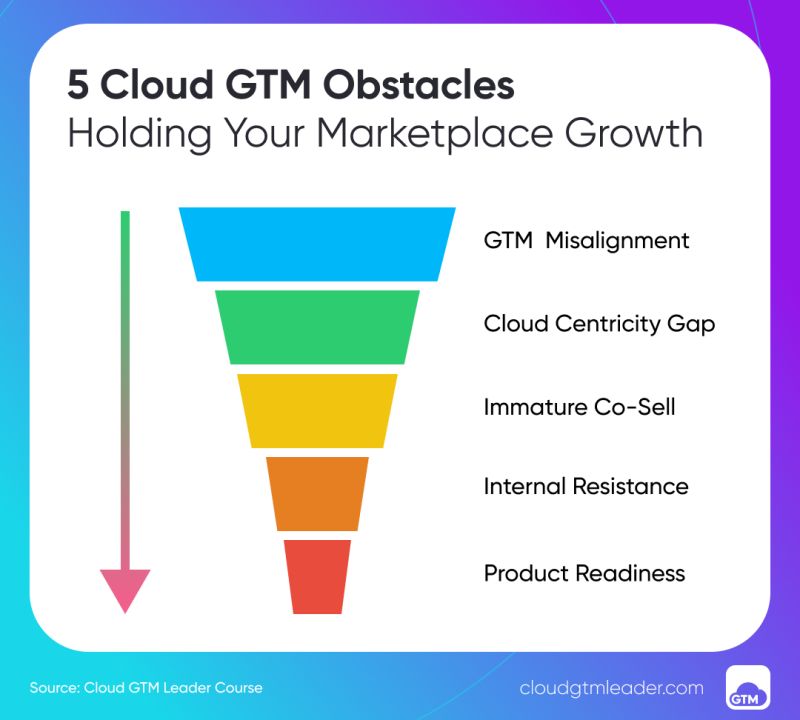
1️⃣ Strategic Cloud GTM Misalignment
The most critical blocker isn’t technical—it’s strategic.
Many companies treat cloud marketplaces as "just another channel," but success demands a fundamental GTM shift.
Winning in cloud marketplaces requires embracing a partner-led, customer-centric, consumption-focused model where you align with the cloud provider’s priorities—not the other way around.
You’re entering ecosystems of Amazon Web Services (AWS), Microsoft Azure, or Google Cloud as their partner, not the reverse.
2️⃣ Cloud & Customer Centricity Gap
The "build it and they will come" approach fails spectacularly on marketplaces.
Successful ISVs deeply embed themselves in the cloud ecosystem by:
Mapping their solution to the cloud provider’s growth areas and strategic initiatives.
Understanding how and why customers discover, evaluate, and buy solutions in cloud marketplaces and on each cloud platform.
Aligning GTM motions with the cloud provider’s sales cycles and engagement models.
3️⃣ Immature Co-Sell
Many SaaS companies struggle with co-sell readiness, held back by ingrained direct sales cultures, concern of conflict (channel/competition) and lack of Cloud GTM understanding.
Incentives: Sales teams aren’t motivated (or de-motivated) to collaborate with cloud reps or sell through marketplaces.
Value Proposition: SaaS companies fail to articulate how their solution complements the cloud provider’s offerings and drives customer value.
Program Knowledge: ISVs often miss out on cloud program benefits because they don’t meet requirements or focus enough on eligibility.
4️⃣ Lack of Alignment and Internal Resistance
The most insidious obstacle often comes from within:
Siloed Departments: Sales, marketing, product, and finance don’t collaborate effectively, hindering a unified marketplace strategy.
Leadership Gaps: Executives may not fully grasp the strategic importance of cloud marketplaces, leading to misaligned priorities or underinvestment.
Not leveraging marketplace data and insights and not integrating MP into your sales and company operations
5️⃣ Cloud-Native Product Reality
Success on cloud marketplaces goes beyond GTM strategy—your product must also be ready... Ideally its architecture should leverage cloud-native services to enhance consumption and scalability.
What This Means
The gap between leaders and laggards in cloud marketplaces is widening.
Those who treat Cloud GTM as a transformation, not just another sales/partner channel, are experiencing rapid growth.
Others risk being left behind in what’s quickly becoming the largest software distribution channel.
What’s the biggest obstacle you’ve encountered?

Latest Insights & Analysis
We help our clients to define customer-centric strategies that stimulate innovation and create value