

Here's the math behind it and why this could be the biggest cloud marketplace opportunity for SaaS and alliance leaders.
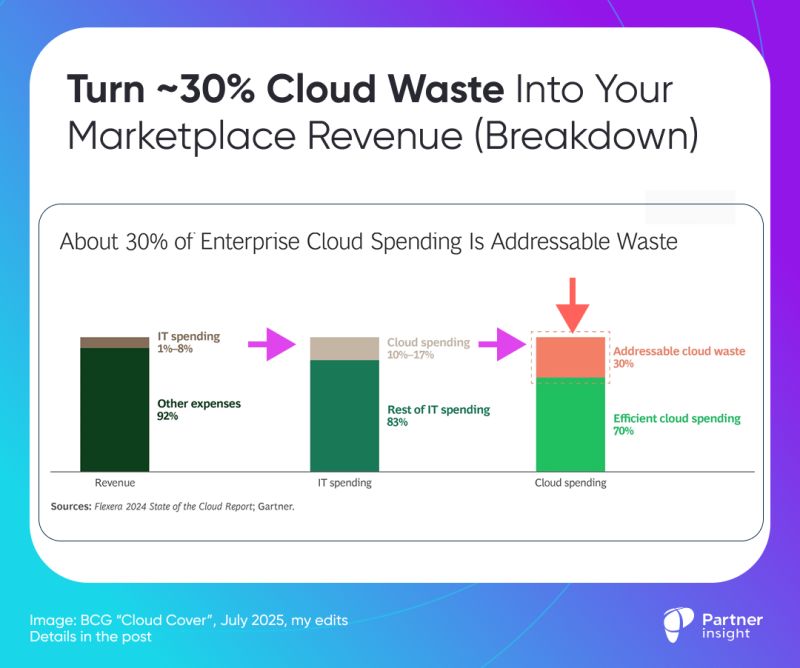
Cloud costs now represent up to 17% of total IT budgets, while IT spending typically accounts for 1-8% of company revenue (BCG, 2025). Median spend is 5% of ARR for hosting alone in private B2B SaaS (SaaS Capital).
This means cloud spend can reach 1-1.5% of total enterprise revenue. That's not pocket change—for a $100M ARR company, we're talking $1-2M spending annually on cloud.
As companies migrate more workloads and adopt AI, cloud claims growing budget share.
Organizations exceeded their public cloud budgets by 17% last year while planning 28% YoY growth of spend this year—3.5X faster than overall IT spend growth of 7.9% (Flexera, Gartner).
Addressable waste is real and massive
Boston Consulting Group (BCG)'s latest analysis reveals that ~30% of this cloud spend is addressable waste from overprovisioning, poor resource utilization, ineffective discount strategies, data storage inefficiencies, and lack of FinOps practices.
Companies are improving—Flexera puts cloud waste at 27% in 2025 (down from 34% a few years ago).
But given that customers now pay $248B annually to AWS, Azure, and GCP, the scale remains massive (my breakdown of annual run rates).
This is where cloud marketplaces become your strategic lever
96% of organizations already use cloud provider discounts, with significant portions locked into formal contracts (Flexera):
Microsoft Azure: 45% use Azure Enterprise Agreement discounts
Google Cloud: 44% use Google Committed Use discounts
AWS: 40% use AWS Enterprise Discount Program (EDP)
These pre-committed budgets—now totaling $469B across hyperscalers (my analysis- link in comments)—create a natural funnel to marketplaces, where customers can apply existing cloud spend toward third-party software purchases.
The math is compelling. If even half of that 27% waste redirects to productive marketplace purchases, we're talking billions in accessible budget that doesn't require new approvals or procurement cycles.
This also creates win-win-win for SaaS alliance leaders, hyperscalers and cloud customers.
What this means for alliance leaders:
Efficiency positioning:
Position buying your SaaS on marketplace as helping customers maximize ROI on existing cloud commitments
Budget accessibility:
Tap into revenue already committed/signed to cloud spend. Plus it’s a broader cloud optimization for them too.
Growth leverage:
Ride the 28% annual growth wave by embedding your solutions in customer cloud procurement workflows
What's your strategy for turning cloud commits into your marketplace wins?

Join 250+ alliance leaders who’ve mastered cloud marketplaces of Azure, AWS and Google Cloud with our Cloud GTM Leader course. Our alumni are closing $MMs in marketplace deals and scaling fast. Cohort 12 starting on September 9th!

Latest Insights & Analysis
We help our clients to define customer-centric strategies that stimulate innovation and create value