

The answer we heard last week: embed Marketplace in the company’s operating model.
Sellers know when and how to bring in AWS.
Buyer signals show up in the tools they already use.
Executives stay in the loop and help define what success looks like.
Repeatable work gets automated, so people focus on relationships and complex deals.
Last Thursday, we hosted How to Scale on AWS Marketplace with a Lean Team. Four leaders joined me to unpack what this looks like in practice, from AWS's program view to operators who built the motion from near zero.
Michael Levy, Senior Manager, AWS Marketplace Development at AWS
Shriya Hahn, Head of AWS Alliance at Vercel
Sarah Jackson, Global Alliance Strategy Manager at NiCE
Trunal Bhanse, CEO of Clazar
Here are 10 insights that stood out.
1. Bring Marketplace in early, and track what it does to your deals
Shriya shared how Vercel moved Marketplace from a late-stage procurement step to a Marketplace-first motion, while still letting customers choose how they buy.
The result over two years:
"We've seen both our deal sizes get larger and longer as well. We've seen a meaningful step change in multi-year contracts and TCV value."
The takeaway: bring Marketplace in early where it creates customer value, and track KPIs.
2. Show AWS sellers how you advance their goals
Vercel built its pitch around what AWS cares about:
"How are we driving more AWS consumption? Are we retaining a workload on AWS, or are we even opening the door to a customer conversation that they haven't been able to get into?"
A stronger co-sell conversation starts with what you can contribute to their goals, alongside the help you need.
3. Turn a few vertical wins into a repeatable co-sell motion
Sarah Jackson from NiCE recommended concentrating on an industry where you already have customer overlap and a couple of successful deals. Take those stories back to AWS: the customer problem, what you did together, and the outcome.
Michael added that AWS's salesforce is increasingly verticalized, so one customer win can often be repeated by the account team sitting next to it.
4. Use industry competencies to connect differentiation with funding
Michael explained how industry competencies signal readiness to serve a particular vertical and can open access to funding and co-marketing opportunities.
Prioritize competencies that support the customers you want to reach, then understand which benefits are available and how to use them in your GTM plan.
5. Turn propensity signals into prompts inside the sales process
Vercel's GTM engineering team built automated Slack alerts. As a deal moves through the CRM, the customer channel gets a note that flags high-intent accounts and prompts the seller to engage early.
The takeaway: make account intelligence trigger a seller action in your CRM or Slack, so the alliance team isn't chasing every opportunity by hand.
6. Check buyer signals before a co-sell opportunity exists
Trunal Bhanse from Clazar explained that company-level signals can help sellers identify potential Marketplace fit and commitment drawdown eligibility before engaging AWS on a specific deal.
The takeaway: use account signals to prioritize prospecting, then validate the customer's actual buying situation.
7. Build co-marketing around named accounts
Instead of big events, Vercel runs small executive roundtables with AWS:
"AWS brings their executive relationships, we bring ours, and together we're really able to create a much more meaningful conversation."
Afterward, both teams align on which accounts to co-sell.
8. Agree what success looks like with each executive
Sarah’s advice was simple: don’t assume your CMO, CRO, and partner leader expect the same result from Marketplace and cloud partnership investments.
“What would ultimately an awesome outcome look like for you? And how can I work backwards from that?”
Ask before committing time and budget, then revisit those expectations as priorities change.
9. Automate smaller deals with Express Private Offers
Michael described how Express Private Offers now let sellers define pricing and qualification criteria so buyers can receive a private offer through an automated process.
For sales-led companies with many smaller deals, this creates an opportunity to reserve more human attention for complex enterprise opportunities.
10. Marketplace is moving into discovery and evaluation
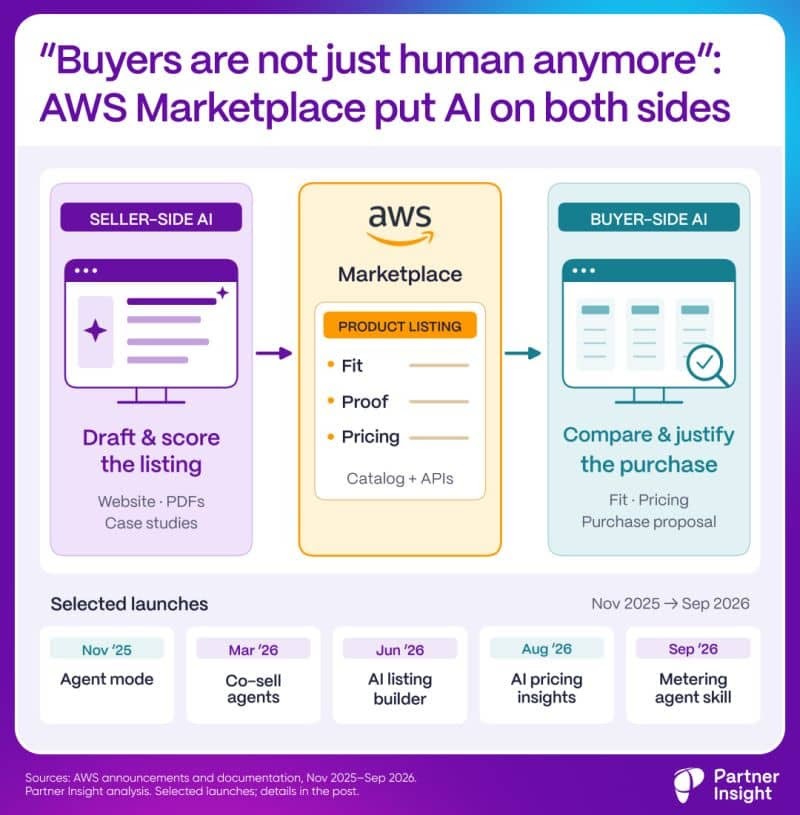
Michael also highlighted AWS’s work on agent-assisted search, pricing insights, and product comparisons, extending Marketplace’s role across the buying journey.
The takeaway: your listing now shapes how buyers and AI find and compare you. Michael suggested running older listings through the new AI listing experience.
What ties it together
Put the 10 insights side by side and three moves stand out.
Focus. Pick the verticals and accounts where you already have customer overlap. Prioritize competencies that support those markets. Turn a few wins into stories AWS sellers can repeat.
Embed. Bring Marketplace into the deal early. Put signals inside the CRM and Slack. Agree what success means with each executive.
Automate. Let technology handle alerts and repeatable private-offer workflows, so people spend their time on co-sell relationships and complex deals.
That's how a lean team scales Marketplace across a much larger company. The Marketplace team designs and coordinates the system, and the rest of the business runs it.
Thank you to Clazar for supporting this session.

Latest Insights & Analysis
We help our clients to define customer-centric strategies that stimulate innovation and create value