
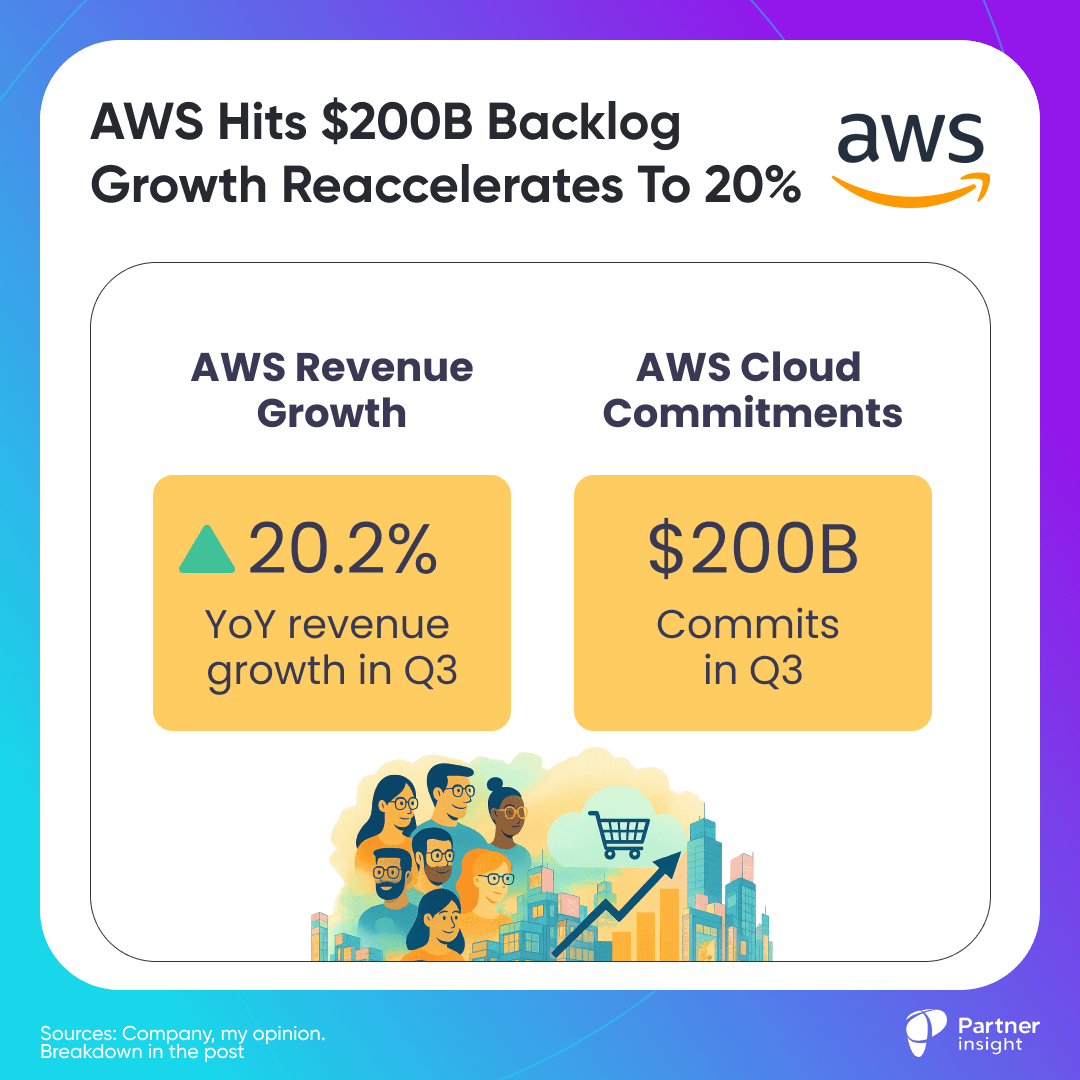
But the headline number only tells part of the story: AWS backlog reached $200B in Q3 , and October deals—the first month of Q4—already exceeded the entire Q3’s deal volume.
That forward momentum signals enterprises are racing to lock in multi-year cloud commitments as AI workloads drive cloud and AI demand.
AWS Momentum Driven by AI and Core Migration
CEO Andy Jassy emphasized AWS is “growing at a pace we haven’t seen since 2022, reaccelerating to 20.2% year-over-year.”
He noted this is “very different having 20% year-over-year growth on a $132 billion annualized run rate” compared to competitors with smaller revenue bases.
The growth spans both traditional cloud migrations and new AI workloads. “We’re really pleased with the results from this quarter,” Jassy said.
“We see the growth in both our AI area, where we see it in inference. We see it in training. We see it in the use of our Trainium custom silicon. Bedrock continues to grow really quickly. SageMaker continues to grow quickly.”
Cloud Commits at $200B, Q4 Opening with Record Velocity
AWS backlog grew to $200 billion by the end of Q3 (ending September 30). Even more significantly, new deals signed in October—the first month of Q4—already exceeded the total deal volume for the entire third quarter. That procurement velocity suggests Q4 could deliver substantial backlog growth, with enterprises pulling forward multi-year commitments to secure capacity and lock rates.
CFO Brian Olsavsky noted, “AWS revenue increased $2.1 billion quarter-over-quarter,” highlighting both strong new bookings and healthy consumption of existing commits.
AI Infrastructure at Scale: Trainium2 Fully Subscribed, Project Rainier Live
AWS’s custom silicon strategy is paying off. Trainium2 is fully subscribed and has become a multibillion-dollar business, growing 150% quarter-over-quarter, according to Jassy.
The company brought Project Rainier online—a massive AI compute cluster spanning multiple U.S. data centers with nearly 500,000 Trainium2 chips. Anthropic is currently using it to train Claude, with plans to scale to over 1 million Trainium2 chips by year-end.
“It’s not simple to be able to build a cluster that has 500,000 plus chips going to 1 million. That’s an infrastructure feat that’s hard to do at scale,” Jassy explained, highlighting AWS’s differentiation in deploying AI infrastructure.
On chip roadmap, Jassy revealed: “Trainium3 should preview at the end of this year with much fuller volumes coming in the beginning of ‘26.” He expects Trainium3 will deliver “about 40% better than Trainium2 and Trainium2 is already very advantaged on price performance.”
AWS is also building Bedrock “to be the biggest inference engine in the world and in the long run, believe Bedrock could be as big a business for AWS as EC2, and the majority of token usage in Amazon Bedrock is already running on Trainium.”
Agents Become Enterprise Reality with AgentCore
AWS launched AgentCore in Q3, a set of infrastructure building blocks for deploying secure, scalable AI agents. The response has been rapid: AgentCore’s SDK has been downloaded over 1 million times since launch.
“A lot of the future value companies will get from AI will be in the form of agents,” Jassy said. “Companies will both create their own agents and use agents from other companies. For those building their own, it’s been harder to build than it should be.”
Early enterprise adopters include Ericsson (deploying AI agents across their workforce), Sony (building an agentic AI platform with enterprise security), and Cohere Health (using AgentCore to reduce medical review times by 30-40%).
$125B in 2025 CapEx, Power is the Bottleneck
Amazon is investing at unprecedented scale to meet AI demand.
CapEx reached $34.2 billion in Q3, bringing year-to-date spending to $89.9 billion. Full-year 2025 CapEx is expected to hit approximately $125 billion, with an expected increase in 2026.
AWS stressed that it added more than 3.8 gigawatts of power capacity in the past 12 months—more than any other cloud provider—with plans to double total capacity by 2027. In Q4 alone, AWS expects to add at least another 1 gigawatt.
When asked about capacity constraints, Jassy was direct:
“We’re bringing in quite a bit of capacity today, overall in the industry, maybe the bottleneck is power. I think at some point, it may move to chips, but we’re bringing in quite a bit of capacity. And as fast as we’re bringing in right now, we are monetizing it.”
On chip supply specifically, he noted:
“We’re always going to have multiple chip options for our customers... We have a very deep relationship with NVIDIA. We have for a very long time. And we will for as long as I can foresee the future. We buy a lot of NVIDIA. We are not constrained in any way in buying NVIDIA, and I expect that we’ll continue to buy more NVIDIA both next year and in the future.”
Enterprise Wins Across Industries
AWS highlighted that it “continues to earn most of the big enterprise and government transformations to the cloud”. New customer agreements and expansions this quarter included: Delta Air Lines, Volkswagen Group, AXA, BT Group, and Perplexity.
“AWS is where the preponderance of company’s data and workloads reside and part of why most companies want to run AI and AWS,” Jassy said, emphasizing the platform’s stickiness as enterprises layer AI capabilities onto existing cloud foundations.
AWS’s 20.2% reacceleration on a $132B run rate—combined with record backlog and capacity expansion—positions the platform as the infrastructure backbone for enterprise AI at scale.

Latest Insights & Analysis
We help our clients to define customer-centric strategies that stimulate innovation and create value