

When Microsoft partners with OpenAI while competing with them, and Amazon doubles down on Google-backed Anthropic, you know the rules have changed.
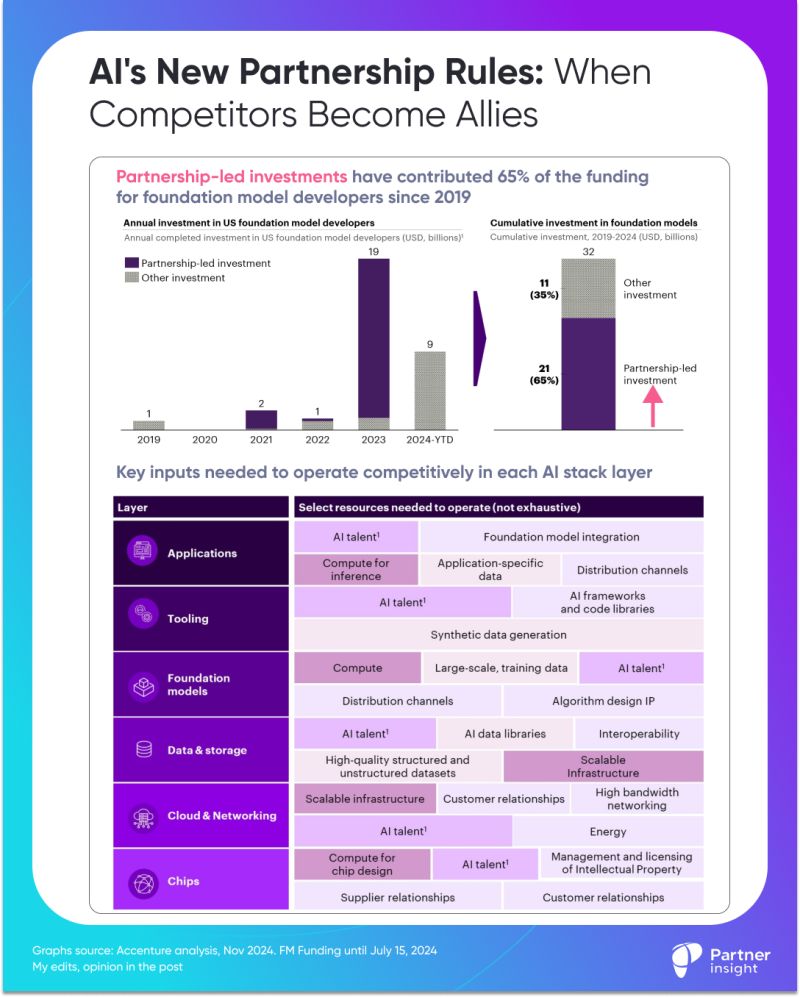
When a single model like last year's Gemini Ultra costs $190M just to develop, even tech giants with deep pockets can't put all pieces of the puzzle together alone. Just think about all the layers of the stack, product use cases, and distribution channels.
"Cross-ecosystem collaboration is critical to mobilizing the investment and capabilities that different ecosystem participants require to innovate and facilitate broader adoption of gen AI," a recent Accenture analysis reveals.
The telling proof? A striking 65% of $32Bn invested in foundation models (2019 - mid 2024) is partnership-led.
But it's not just about training LLMs or building data centers. Partnerships are critical across all six layers of the AI Stack.
📊 AI Stack's Key Dependencies (examples):
Applications Layer needs:
Foundation model integration
Application-specific data
Distribution channels to reach users
Tooling Layer (model hubs, data orchestration) needs:
AI frameworks and code libraries
Synthetic data generation
Foundation Model Layer need:
Massive compute resources
Large-scale training datasets
Distribution channels
Data & Storage Layer needs:
High-quality structured/structured datasets
Scalable infrastructure and Interoperability
Cloud & Networking Layer needs:
High bandwidth networking
Customer relationships (distribution)
Chips Layer needs:
Compute for chip design
Supplier and Customer relationships
4 Key Partnership Types Emerging in the Ecosystem:
Chips + Cloud
Chip makers gain cloud integration expertise and broader market reach
Cloud providers get access to high-performance AI chips
Clouds + Foundation Models
Cloud providers gain cutting-edge foundation models (eg. GPT)
Model developers get infrastructure for broader deployment and scaling
Data/Storage + Foundation Models
Data companies expand market reach by supporting AI workloads
Model developers get access to scalable data and storage solutions
Foundation Models + Applications
Model developers reach new markets through AI-driven applications
App developers get Foundation model integration capabilities
What makes AI partnerships unique is how they've created incredible incentives for deep collaboration.
Unlike previous tech waves where companies could succeed by controlling key parts of the stack, AI's complexity and resource demands force even the largest players to seek complementary capabilities.
Tech companies are aggressively pursuing multiple parallel alliances rather than (while?) trying to fully vertically integrate. It's about creating an ecosystem where innovation happens through collaboration and co-competition.

Latest Insights & Analysis
We help our clients to define customer-centric strategies that stimulate innovation and create value