

As cloud marketplaces evolve from distribution channels to strategic growth drivers, you can use this framework as a roadmap for your businesses to capitalize on this shift.
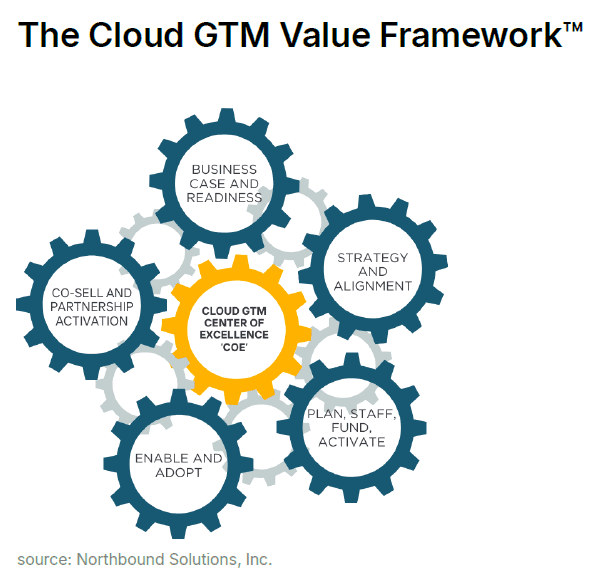
Each component in the framework is a step towards operating "maturity" in Cloud GTM. It underscores that success in cloud marketplaces is about fundamentally aligning business processes, partnerships and co-sell with the cloud ecosystems.
In short, your journey to selling with hyperscale cloud providers and selling through Cloud Marketplaces is a step towards modernizing your go-to-market.
By following these guidelines, businesses can leverage growing cloud marketplace opportunities, drive higher conversions, and establish robust partnerships with hyperscalers.
Let’s dive in:
Step 1: Prepare a business case and assess readiness
Cloud marketplaces have emerged as a compelling avenue for more efficient revenue generation. These platforms, with a $45Bn+ in market opportunity, are reshaping SaaS sales, offering a seller-friendly, ecosystem-first approach. Ultimately, they are transforming interactions among buyers, sellers, and channel partners.
However, cloud GTM currently represents less than 5% of the global software and cybersecurity market. This stark disparity signals both a significant opportunity and a challenge for SaaS companies looking to optimize their GTM.
Therefore, the first step in the Cloud GTM Value Framework is to assess organizational readiness for Cloud GTM adoption and define a clear strategy.
You also need to assess the impact on quote-to-cash and other internal functions from adopting cloud marketplace policies and practices, which vary significantly by cloud.
Create a business case supporting the Cloud GTM motion. The case should reference impact on corporate strategy, potential challenges in field and customer adoption, and recommend a strategic direction aligned with business objectives.
Key Activities:
Set Strategic Goals: Define clear, measurable goals for Cloud GTM adoption aligned with overall business objectives. Consider a 2-year time horizon.
Assess Readiness: Evaluate current product infrastructure, applications, and processes to determine cloud compatibility. Assess process implications and impacts on functional teams.
Build a Business Case: Create a compelling business case highlighting the benefits, costs, and ROI of cloud adoption.
Engage Stakeholders: Involve key stakeholders from key departments involved in Cloud GTM to gather insights and ensure alignment. Inform functional leaders of process changes for sales, revenue operations, finance/accounting/tax/legal, marketing, channels, etc.
Step 2: Set strategy and align leadership
In addition to a clear strategy, successful Cloud GTM adoption requires alignment among leadership. Focus on securing executive sponsorship, establishing functional goals, and ensuring leadership alignment to drive the cloud initiative forward.
Align sales goals with partnership and cloud GTM objectives and eliminate friction in the process (most commonly involving compensation). Ensure all stakeholders are grounded around the same plan.
Key Activities:
Executive Sponsorship: Secure commitment from top executives to champion the cloud initiative.
Leadership Alignment: Conduct workshops and meetings to align leadership on the cloud strategy and objectives.
Communication Plan: Develop a communication plan to keep all stakeholders informed and engaged.
Roadmap Development: Create a high-level roadmap outlining key milestones, resources, and timelines.
Step 3. Plan, staff, budget, and activate your Cloud GTM system
Initially, make cloud GTM part of the existing sales process, assigning the CRO or Head of Sales as the (co) owner. Focus on closing more deals through the cloud, developing commission plans, and integrating field engagement within CRM systems.
Help customers use their cloud commit while maintaining strong relationships between customers and sales reps. As cloud GTM matures, consider separating responsibilities between direct sales and partner-led/marketplace-aligned sales teams.
Build reliability in Cloud GTM to establish new partnerships and transition existing ones to the cloud, aligning the partnership team to drive more opportunities through cloud marketplaces. Track the impact of partnerships on conversions to boost conversions by better alignment with partners.
Leverage cloud GTM platforms like Tackle to streamline the cloud GTM motion across hyperscalers, achieve faster deal cycles, and scale Co-Sell efforts with native CRM integrations.
Key Activities:
Process Mapping: Map existing processes to identify areas impacted by cloud adoption.
Change Management Plan: Develop a change management plan to address process changes, including training, communication, and support.
Risk Management: Identify potential risks associated with process changes and develop mitigation strategies.
Pilot Programs: Implement pilot programs to test new processes and gather feedback. Start where you are best positioned to win with the Cloud Provider. Focus your efforts, measure, optimize, socialize, repeat.
Step 4: Enable, adopt, measure, and improve your activities
Step 5: Activate Co-sell and optimize partnerships
You can read about Steps 4 and 5 in Jonathan’s whitepaper here
The real test of your strategy is its execution. As cloud marketplaces grow, the ability not only set, but also implement effective strategies is what will differentiate market leaders from laggards.

Latest Insights & Analysis
We help our clients to define customer-centric strategies that stimulate innovation and create value