
Microsoft’s $392B Cloud Backlog Grows 51% as Azure Surges 40%—Yet Still Capacity Constrained
Microsoft’s $392B Cloud Backlog Grows 51% as Azure Surges 40%—Yet Still Capacity Constrained

Microsoft delivered a blockbuster Q1 FY26 with Azure growing 40% and total commercial RPO exploding to $392 billion—up 51% year-over-year—while revealing capacity constraints will persist through at least June 2026.
Microsoft delivered a blockbuster Q1 FY26 with Azure growing 40% and total commercial RPO exploding to $392 billion—up 51% year-over-year—while revealing capacity constraints will persist through at least June 2026.
Demand for AI infrastructure is outpacing even Microsoft’s aggressive buildout, with the company set to increase total AI capacity by 80% this year and double datacenter footprint over the next two.
Cloud Commits Hit $392B with Only 2-Year Duration
Total commercial remaining performance obligation reached $392 billion (+51% YoY) with commercial bookings up 112% driven by Azure commitments from OpenAI and “continued growth in the number of $100M+ contracts for both Azure and M365.”
The story isn’t just the size—it’s the velocity and breadth.
CFO Amy Hood emphasized the backlog has “nearly doubled over the past two years” while maintaining a weighted average duration of approximately 2 years, meaning this massive contracted base converts to revenue fast.
“With a nearly $400 billion balance... it covers numerous products. It covers customers of all sizes. And that’s been a balance that we’ve been growing, obviously, at a good clip... Most of that is being consumed in relatively short order.” — Amy Hood, CFO
“These are contracts being signed by customers who intend to use it in relatively short order,” Hood emphasized, pushing back on concerns about commitments being either too concentrated or long-dated. “People are not consuming... unless there’s value.”
Post-quarter, Microsoft announced OpenAI contracted an additional $250 billion of Azure services, extending their partnership through 2030-2032 (depending on AGI milestones). This incremental commitment will hit upcoming bookings.
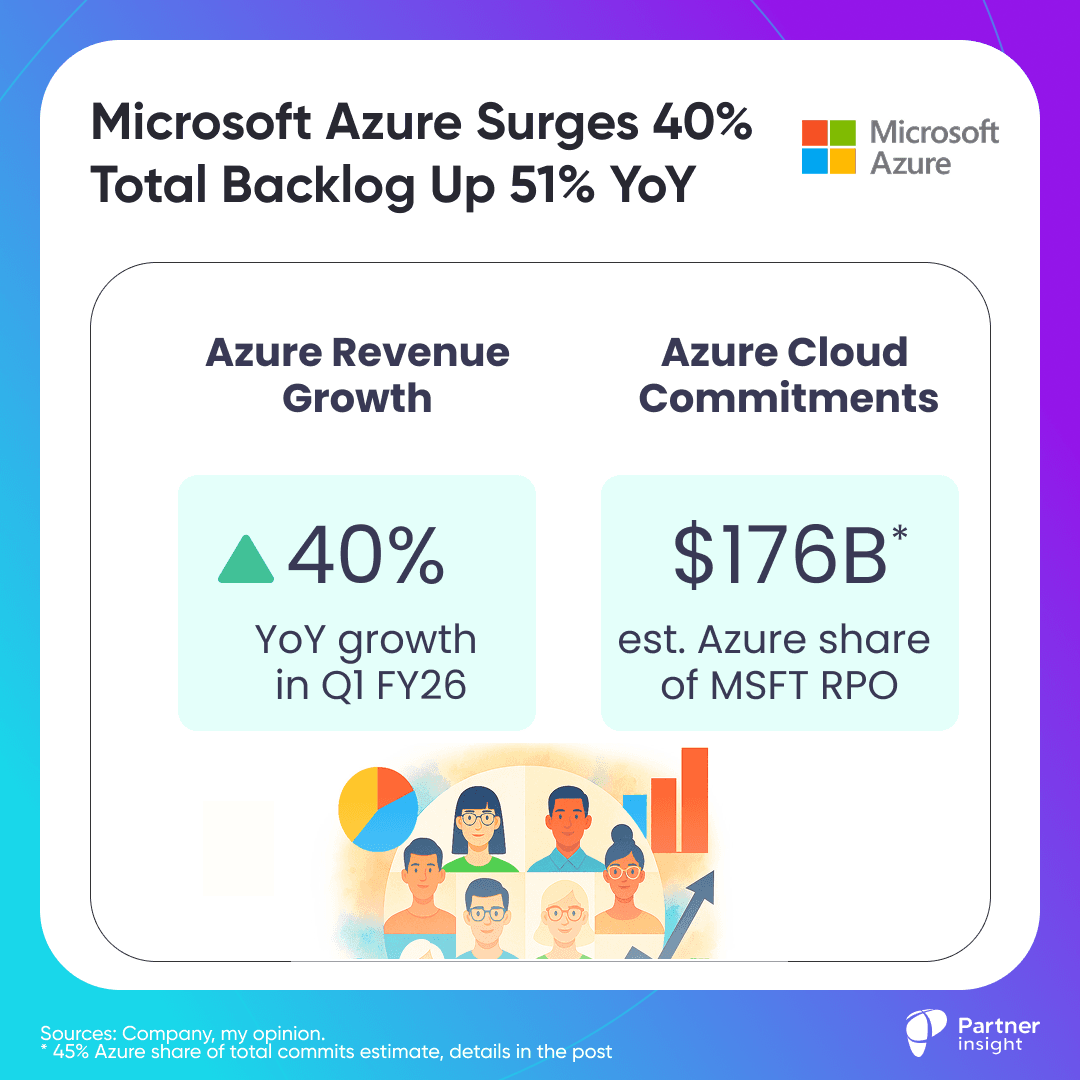
Azure: +40% YoY
Azure commits: $176.4B*
See my separate breakdown of Azure cloud commits above.
* Azure share calculated as 45% of Microsoft total backlog, based on CEO comments last quarter about Azure’s run rate and its share in Microsoft Cloud.
The AI Platform Hits Production Scale
Microsoft’s AI momentum is moving from pilot to production.
CEO Satya Nadella highlighted 900 million monthly active users across AI features and 150 million MAU for first-party Copilots spanning M365, GitHub, Security, Health, and Consumer.
Azure AI Foundry now serves 80,000 customers (including 80% of Fortune 500) with access to 11,000+ models—more than any other vendor.
“We offer developers and enterprise access to over 11,000 models, more than any other vendor, including as of this quarter OpenAI’s GPT-5, as well as xAI’s Grok 4.” — Satya Nadella, CEO
Nadella highlighted examples like Ralph Lauren using Foundry to build conversational shopping and OpenEvidence creating an AI clinical assistant—both production workloads at scale.
Copilot Adoption Accelerates
Microsoft 365 Copilot crossed a milestone: over 90% of Fortune 500 now use it, with adoption accelerating 50% quarter-over-quarter in Copilot Chat usage.
Major enterprise deployments this quarter:
PwC: added 155,000 seats in Q1 alone, now 200,000+ deployed globally with 30M Copilot interactions in six months
Lloyds Banking Group: 30,000 seats saving employees an average 46 minutes daily
Accenture, EY Global, UK tax authority, etc.: each purchased 15,000+ seats
GitHub Copilot reached 26 million users as the platform added a developer every second to hit 180 million total developers.
The stickiness signal: 80% of new developers on GitHub start with Copilot within their first week.
Over 500 million pull requests merged in the past year, driven by AI coding agents.
The Agent Ecosystem Takes Shape
Microsoft’s bet on agents as the next platform layer is now boosted by ISV adoption and co-build.
“We are seeing a growing Copilot agent ecosystem, with top ISVs like Adobe, Asana, Jira, LexisNexis, SAP, ServiceNow, Snowflake, and Workday all building their own agents that connect to Copilot.” — Satya Nadella
Infrastructure Buildout Matches Unprecedented Demand
Microsoft’s capacity expansion is aggressive but still falling short of demand.
“We will increase our total AI capacity by over 80% this year, and roughly double our total datacenter footprint over the next two years, reflecting the demand signals we see.” — Satya Nadella
This quarter they announced Fairwater, Wisconsin—the world’s most powerful AI datacenter at 2 gigawatts capacity, going online in 2026. Microsoft also deployed the first large-scale cluster of NVIDIA GB300s.
Q1 Capex: $34.9 billion (+74% YoY)
~50% short-lived assets (GPUs/CPUs matched to contract durations)
~50% long-lived assets (datacenters, 10Y+ long term monetization)
Amy Hood confirmed FY26 capex growth will be higher than FY25, with sequential increases.
“With accelerating demand and a growing RPO balance, we’re increasing our spend on GPUs and CPUs. Therefore, total spend will increase sequentially, and we now expect the FY26 growth rate to be higher than FY25.” — Amy Hood
Critically, Hood noted Microsoft expects to be capacity constrained through at least end of fiscal year (June 2026), even as they bring more capacity online. Demand continues to exceed supply across workloads.
Azure growth expectations
37% growth in Q2 & capacity-constrained through FY26 (at least)
CFO Amy Hood: “In Azure, we expect Q2 revenue growth of approximately 37% in constant currency as demand remains significantly ahead of the capacity we have available…”
On “AGI” and Microsoft’s Platform Advantage
Addressing whether advances like AGI could weaken Microsoft’s positioning, Satya Nadella emphasized the enduring need for orchestration:
“Even as the intelligence capability increases, let’s even say, exponentially, model version over model version, the problem is, it’s always going to still be jagged... You may even have a capability that’s fantastic at a particular task, but it may not uniformly grow... Even when the model is magical, all powerful, I think we will be in this jagged intelligence phase for a long time.” — Satya Nadella
Even as models become more powerful, they’ll maintain “spiky” performance—exceptional at some tasks, weak at others. This creates persistent demand for orchestration systems that smooth out the jagged edges.
Microsoft is betting that platforms like GitHub Copilot, M365 Copilot, and Security Copilot become the trusted enterprise orchestration layers—more valuable than raw model access alone.
“Whether it is GitHub Agent HQ or the M365 Copilot system... it’s a system that, in some sense, smooths out those jagged edges and really helps the capability.” — Satya Nadella
ISVs building agent frameworks, workflow integration, and governance layers are likely stronger positioned to capture this value too.
Google Cloud Hits $155B Backlog, Revenue up 34% and AI Reaches “Billions in Quarterly Revenue”
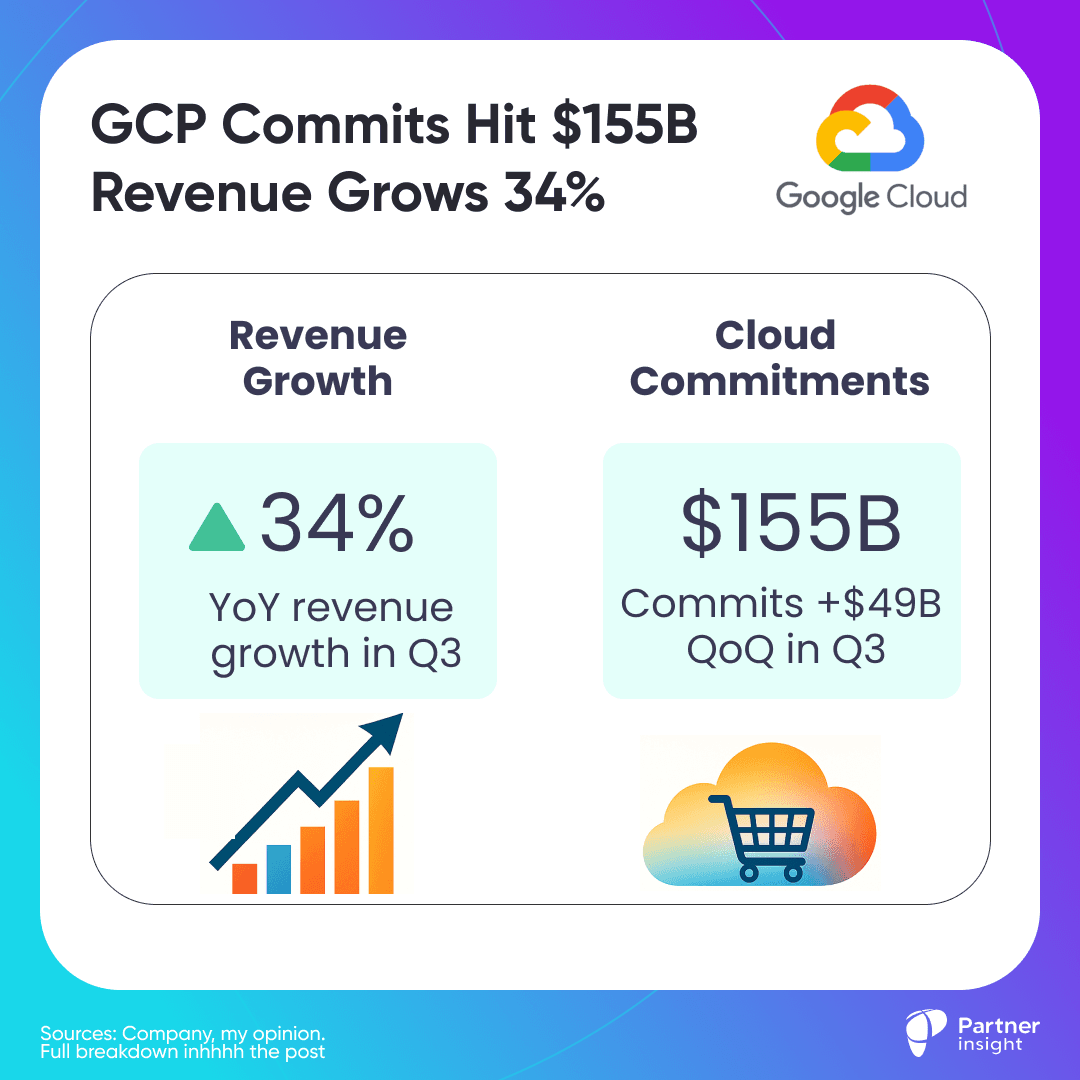
Alphabet’s Q3 performance was excellent, but it was strongest in Google Cloud. revenue accelerated to 34% growth, and AI demand pulled backlog to $155 billion—a $49 billion sequential jump.
“Alphabet had a terrific quarter… We delivered our first-ever $100 billion quarter,” said CEO Sundar Pichai.
He added: “Our full stack approach to AI is delivering strong momentum… our first party models, like Gemini, now process 7 billion tokens per minute… Google Cloud accelerated, ending the quarter with $155 billion in backlog.”
But the headline number only tells part of the story—Google has signed more billion-dollar deals in the first nine months of 2025 than in the previous two years combined, signaling enterprise cloud and AI procurement is rapidly accelerating.
Cloud Commits: The Largest Sequential Jump on Record
Google Cloud’s backlog reached $155 billion, adding $49 billion in a single quarter— this represents the largest sequential backlog increase Google has disclosed.
CFO Anat Ashkenazi directly connected the surge to AI momentum:
“Google Cloud’s backlog increased 46% sequentially and 82% year-over-year, reaching $155 billion at the end of the third quarter. The increase was driven primarily by strong demand for enterprise AI.”
CEO Sundar Pichai emphasized the deal velocity shift “We have signed more deals over $1 billion through Q3 this year than we did in the previous two years combined.”
The backlog surge comes amid persistent capacity constraints.
“While we have been working hard to increase capacity and have improved the pace of server deployments and data center construction, we still expect to remain in a tight demand/supply environment in Q4 and 2026,” Ashkenazi cautioned.
Deal Velocity Accelerating Across All Dimensions
Google Cloud’s growth is broadening beyond just expanding existing accounts.
Customer acquisition: “The number of new GCP customers increased by nearly 34% year-over-year,” Pichai reported.
AI adoption penetration: “Over 70% of existing Google Cloud customers use our AI products, including Banco BV, Best Buy, and FairPrice Group,” Pichai said.
Product diversification:
“Today, 13 product lines are each at an annual run rate over $1 billion, and we are improving operating margin with highly-differentiated products built with our own technology,” Pichai noted.
The newest product making waves is Gemini Enterprise.
“Earlier this month, we launched Gemini Enterprise, the new front door for AI in the workplace, and we are seeing strong adoption for agents built on this platform,” Pichai said. “We have already crossed two million subscribers across 700 companies”—a remarkable pace for a recently launched enterprise product.
AI Revenue Reaches Scale & 1.3 Quadrillion Monthly Tokens
Google’s enterprise AI business is now driving billions in quarterly revenue. CFO Anat Ashkenazi confirmed:
“GCP’s growth was driven by enterprise AI products, which are generating billions in quarterly revenue.”
Their Gen AI products revenue specifically are tripling:
“In Q3, revenue from products built on our generative AI models grew more than 200% year-over-year,” Pichai stressed.
The scale of AI workload adoption is staggering
“Over the past 12 months, nearly 150 Google Cloud customers each processed approximately one trillion tokens with our models for a wide range of applications,”
Pichai said, citing examples like WPP achieving 70% efficiency gains in campaign creation and Swarovski seeing a 17% increase in email open rates with 10x faster campaign localization.
Token processing volume tells the adoption story:
“In July, we announced that we processed 980 trillion monthly tokens across all our surfaces. We are now processing over 1.3 quadrillion monthly tokens, more than 20x growth in a year. Phenomenal,” Pichai emphasized.
The Full-Stack AI Differentiator
Google positioned its unique vertical integration as a competitive moat. “We are the only Cloud provider offering our own leading generative AI models, including Gemini, Imagen, Veo, Chirp and Lyria,” Pichai stated.
On infrastructure, Pichai highlighted their dual-track approach:
“We are scaling the most advanced chips in our data centers, including GPUs from our partner NVIDIA, as well as our own purpose-built TPUs, and we are the only company providing a wide range of both.”
The TPU strategy is gaining serious traction.
“We’re investing in TPU capacity to meet the tremendous demand we are seeing from customers and partners, and we’re excited that Anthropic recently shared plans to access up to one million TPUs,” Pichai announced.
CapEx Surge to Meet Strong Demand
Google raised its 2025 capital expenditure guidance to $91-93 billion, up from the previous estimate of $85 billion.
“Looking out to 2026, we expect a significant increase in CapEx,” CFO Ashkenazi stated.
Q3 alone saw $24 billion in CapEx, with “approximately 60% of that investment in servers and 40% in data center and networking equipment,” Ashkenazi detailed.
Despite this massive buildout, supply constraints persist.
“while we have been working hard to increase capacity and have improved the pace of server deployments and data center construction, we still expect to remain in a tight demand/supply environment in Q4 and 2026,” Ashkenazi emphasized.
The demand visibility gives Google confidence to invest aggressively.
“We’re continuing to invest aggressively due to the demand we’re experiencing from Cloud customers as well as the growth opportunities we see across the company,” Ashkenazi said.
The Infrastructure Stakes
Google’s earnings reinforced the scale of AI infrastructure demand and the supply constraint reality.
The competitive positioning is clear. Pichai noted that nine of the top ten AI labs choose Google Cloud, driven by “a decade of experience building AI Accelerators and today offer the widest array of chips.”
Gemini Momentum Reinforces Cloud Story
While outside core cloud infrastructure, Google’s Gemini adoption provides important demand signal.
“The Gemini App now has over 650 million monthly active users, and queries increased by 3x from Q2,” Pichai highlighted.
Google’s 46% sequential backlog jump—suggests enterprise AI and cloud procurement cycles are compressing dramatically. With Google confirming the “tight supply environment” will persist well into 2026, strategic positioning in the GCP ecosystem becomes increasingly valuable.
P.S. If you found these insights valuable, please forward it to your alliance lead or cloud/GTM counterpart - it’s how this community shares what works.
Demand for AI infrastructure is outpacing even Microsoft’s aggressive buildout, with the company set to increase total AI capacity by 80% this year and double datacenter footprint over the next two.
Cloud Commits Hit $392B with Only 2-Year Duration
Total commercial remaining performance obligation reached $392 billion (+51% YoY) with commercial bookings up 112% driven by Azure commitments from OpenAI and “continued growth in the number of $100M+ contracts for both Azure and M365.”
The story isn’t just the size—it’s the velocity and breadth.
CFO Amy Hood emphasized the backlog has “nearly doubled over the past two years” while maintaining a weighted average duration of approximately 2 years, meaning this massive contracted base converts to revenue fast.
“With a nearly $400 billion balance... it covers numerous products. It covers customers of all sizes. And that’s been a balance that we’ve been growing, obviously, at a good clip... Most of that is being consumed in relatively short order.” — Amy Hood, CFO
“These are contracts being signed by customers who intend to use it in relatively short order,” Hood emphasized, pushing back on concerns about commitments being either too concentrated or long-dated. “People are not consuming... unless there’s value.”
Post-quarter, Microsoft announced OpenAI contracted an additional $250 billion of Azure services, extending their partnership through 2030-2032 (depending on AGI milestones). This incremental commitment will hit upcoming bookings.
Azure: +40% YoY
Azure commits: $176.4B*
See my separate breakdown of Azure cloud commits above.
* Azure share calculated as 45% of Microsoft total backlog, based on CEO comments last quarter about Azure’s run rate and its share in Microsoft Cloud.
The AI Platform Hits Production Scale
Microsoft’s AI momentum is moving from pilot to production.
CEO Satya Nadella highlighted 900 million monthly active users across AI features and 150 million MAU for first-party Copilots spanning M365, GitHub, Security, Health, and Consumer.
Azure AI Foundry now serves 80,000 customers (including 80% of Fortune 500) with access to 11,000+ models—more than any other vendor.
“We offer developers and enterprise access to over 11,000 models, more than any other vendor, including as of this quarter OpenAI’s GPT-5, as well as xAI’s Grok 4.” — Satya Nadella, CEO
Nadella highlighted examples like Ralph Lauren using Foundry to build conversational shopping and OpenEvidence creating an AI clinical assistant—both production workloads at scale.
Copilot Adoption Accelerates
Microsoft 365 Copilot crossed a milestone: over 90% of Fortune 500 now use it, with adoption accelerating 50% quarter-over-quarter in Copilot Chat usage.
Major enterprise deployments this quarter:
PwC: added 155,000 seats in Q1 alone, now 200,000+ deployed globally with 30M Copilot interactions in six months
Lloyds Banking Group: 30,000 seats saving employees an average 46 minutes daily
Accenture, EY Global, UK tax authority, etc.: each purchased 15,000+ seats
GitHub Copilot reached 26 million users as the platform added a developer every second to hit 180 million total developers.
The stickiness signal: 80% of new developers on GitHub start with Copilot within their first week.
Over 500 million pull requests merged in the past year, driven by AI coding agents.
The Agent Ecosystem Takes Shape
Microsoft’s bet on agents as the next platform layer is now boosted by ISV adoption and co-build.
“We are seeing a growing Copilot agent ecosystem, with top ISVs like Adobe, Asana, Jira, LexisNexis, SAP, ServiceNow, Snowflake, and Workday all building their own agents that connect to Copilot.” — Satya Nadella
Infrastructure Buildout Matches Unprecedented Demand
Microsoft’s capacity expansion is aggressive but still falling short of demand.
“We will increase our total AI capacity by over 80% this year, and roughly double our total datacenter footprint over the next two years, reflecting the demand signals we see.” — Satya Nadella
This quarter they announced Fairwater, Wisconsin—the world’s most powerful AI datacenter at 2 gigawatts capacity, going online in 2026. Microsoft also deployed the first large-scale cluster of NVIDIA GB300s.
Q1 Capex: $34.9 billion (+74% YoY)
~50% short-lived assets (GPUs/CPUs matched to contract durations)
~50% long-lived assets (datacenters, 10Y+ long term monetization)
Amy Hood confirmed FY26 capex growth will be higher than FY25, with sequential increases.
“With accelerating demand and a growing RPO balance, we’re increasing our spend on GPUs and CPUs. Therefore, total spend will increase sequentially, and we now expect the FY26 growth rate to be higher than FY25.” — Amy Hood
Critically, Hood noted Microsoft expects to be capacity constrained through at least end of fiscal year (June 2026), even as they bring more capacity online. Demand continues to exceed supply across workloads.
Azure growth expectations
37% growth in Q2 & capacity-constrained through FY26 (at least)
CFO Amy Hood: “In Azure, we expect Q2 revenue growth of approximately 37% in constant currency as demand remains significantly ahead of the capacity we have available…”
On “AGI” and Microsoft’s Platform Advantage
Addressing whether advances like AGI could weaken Microsoft’s positioning, Satya Nadella emphasized the enduring need for orchestration:
“Even as the intelligence capability increases, let’s even say, exponentially, model version over model version, the problem is, it’s always going to still be jagged... You may even have a capability that’s fantastic at a particular task, but it may not uniformly grow... Even when the model is magical, all powerful, I think we will be in this jagged intelligence phase for a long time.” — Satya Nadella
Even as models become more powerful, they’ll maintain “spiky” performance—exceptional at some tasks, weak at others. This creates persistent demand for orchestration systems that smooth out the jagged edges.
Microsoft is betting that platforms like GitHub Copilot, M365 Copilot, and Security Copilot become the trusted enterprise orchestration layers—more valuable than raw model access alone.
“Whether it is GitHub Agent HQ or the M365 Copilot system... it’s a system that, in some sense, smooths out those jagged edges and really helps the capability.” — Satya Nadella
ISVs building agent frameworks, workflow integration, and governance layers are likely stronger positioned to capture this value too.
Google Cloud Hits $155B Backlog, Revenue up 34% and AI Reaches “Billions in Quarterly Revenue”
Alphabet’s Q3 performance was excellent, but it was strongest in Google Cloud. revenue accelerated to 34% growth, and AI demand pulled backlog to $155 billion—a $49 billion sequential jump.
“Alphabet had a terrific quarter… We delivered our first-ever $100 billion quarter,” said CEO Sundar Pichai.
He added: “Our full stack approach to AI is delivering strong momentum… our first party models, like Gemini, now process 7 billion tokens per minute… Google Cloud accelerated, ending the quarter with $155 billion in backlog.”
But the headline number only tells part of the story—Google has signed more billion-dollar deals in the first nine months of 2025 than in the previous two years combined, signaling enterprise cloud and AI procurement is rapidly accelerating.
Cloud Commits: The Largest Sequential Jump on Record
Google Cloud’s backlog reached $155 billion, adding $49 billion in a single quarter— this represents the largest sequential backlog increase Google has disclosed.
CFO Anat Ashkenazi directly connected the surge to AI momentum:
“Google Cloud’s backlog increased 46% sequentially and 82% year-over-year, reaching $155 billion at the end of the third quarter. The increase was driven primarily by strong demand for enterprise AI.”
CEO Sundar Pichai emphasized the deal velocity shift “We have signed more deals over $1 billion through Q3 this year than we did in the previous two years combined.”
The backlog surge comes amid persistent capacity constraints.
“While we have been working hard to increase capacity and have improved the pace of server deployments and data center construction, we still expect to remain in a tight demand/supply environment in Q4 and 2026,” Ashkenazi cautioned.
Deal Velocity Accelerating Across All Dimensions
Google Cloud’s growth is broadening beyond just expanding existing accounts.
Customer acquisition: “The number of new GCP customers increased by nearly 34% year-over-year,” Pichai reported.
AI adoption penetration: “Over 70% of existing Google Cloud customers use our AI products, including Banco BV, Best Buy, and FairPrice Group,” Pichai said.
Product diversification:
“Today, 13 product lines are each at an annual run rate over $1 billion, and we are improving operating margin with highly-differentiated products built with our own technology,” Pichai noted.
The newest product making waves is Gemini Enterprise.
“Earlier this month, we launched Gemini Enterprise, the new front door for AI in the workplace, and we are seeing strong adoption for agents built on this platform,” Pichai said. “We have already crossed two million subscribers across 700 companies”—a remarkable pace for a recently launched enterprise product.
AI Revenue Reaches Scale & 1.3 Quadrillion Monthly Tokens
Google’s enterprise AI business is now driving billions in quarterly revenue. CFO Anat Ashkenazi confirmed:
“GCP’s growth was driven by enterprise AI products, which are generating billions in quarterly revenue.”
Their Gen AI products revenue specifically are tripling:
“In Q3, revenue from products built on our generative AI models grew more than 200% year-over-year,” Pichai stressed.
The scale of AI workload adoption is staggering
“Over the past 12 months, nearly 150 Google Cloud customers each processed approximately one trillion tokens with our models for a wide range of applications,”
Pichai said, citing examples like WPP achieving 70% efficiency gains in campaign creation and Swarovski seeing a 17% increase in email open rates with 10x faster campaign localization.
Token processing volume tells the adoption story:
“In July, we announced that we processed 980 trillion monthly tokens across all our surfaces. We are now processing over 1.3 quadrillion monthly tokens, more than 20x growth in a year. Phenomenal,” Pichai emphasized.
The Full-Stack AI Differentiator
Google positioned its unique vertical integration as a competitive moat. “We are the only Cloud provider offering our own leading generative AI models, including Gemini, Imagen, Veo, Chirp and Lyria,” Pichai stated.
On infrastructure, Pichai highlighted their dual-track approach:
“We are scaling the most advanced chips in our data centers, including GPUs from our partner NVIDIA, as well as our own purpose-built TPUs, and we are the only company providing a wide range of both.”
The TPU strategy is gaining serious traction.
“We’re investing in TPU capacity to meet the tremendous demand we are seeing from customers and partners, and we’re excited that Anthropic recently shared plans to access up to one million TPUs,” Pichai announced.
CapEx Surge to Meet Strong Demand
Google raised its 2025 capital expenditure guidance to $91-93 billion, up from the previous estimate of $85 billion.
“Looking out to 2026, we expect a significant increase in CapEx,” CFO Ashkenazi stated.
Q3 alone saw $24 billion in CapEx, with “approximately 60% of that investment in servers and 40% in data center and networking equipment,” Ashkenazi detailed.
Despite this massive buildout, supply constraints persist.
“while we have been working hard to increase capacity and have improved the pace of server deployments and data center construction, we still expect to remain in a tight demand/supply environment in Q4 and 2026,” Ashkenazi emphasized.
The demand visibility gives Google confidence to invest aggressively.
“We’re continuing to invest aggressively due to the demand we’re experiencing from Cloud customers as well as the growth opportunities we see across the company,” Ashkenazi said.
The Infrastructure Stakes
Google’s earnings reinforced the scale of AI infrastructure demand and the supply constraint reality.
The competitive positioning is clear. Pichai noted that nine of the top ten AI labs choose Google Cloud, driven by “a decade of experience building AI Accelerators and today offer the widest array of chips.”
Gemini Momentum Reinforces Cloud Story
While outside core cloud infrastructure, Google’s Gemini adoption provides important demand signal.
“The Gemini App now has over 650 million monthly active users, and queries increased by 3x from Q2,” Pichai highlighted.
Google’s 46% sequential backlog jump—suggests enterprise AI and cloud procurement cycles are compressing dramatically. With Google confirming the “tight supply environment” will persist well into 2026, strategic positioning in the GCP ecosystem becomes increasingly valuable.
P.S. If you found these insights valuable, please forward it to your alliance lead or cloud/GTM counterpart - it’s how this community shares what works.

Scale to $100M+
via Cloud Marketplaces
Join 5,000 GTM leaders
Weekly Newsletter
Scale to $100M+
via Cloud Marketplaces
Join 5,000 GTM leaders
Weekly Newsletter
Scale to $100M+
via Cloud Marketplaces
Join 5,000 GTM leaders
Weekly Newsletter
Latest Insights & Analysis
We help our clients to define customer-centric strategies that stimulate innovation and create value



Join 5,000 GTM leaders
Weekly Newsletter
Scale to $100M+ via Cloud Marketplaces
© 2026 Partner Insight
Join 5,000 GTM leaders
Weekly Newsletter
Scale to $100M+ via Cloud Marketplaces
© 2026 Partner Insight
Join 5,000 GTM leaders
Weekly Newsletter
Scale to $100M+ via Cloud Marketplaces
© 2026 Partner Insight